



E-Commerce•11 Min
How Programmatic SEO Delivered 135,000 Organic Clicks and ~830 Ranked Pages Across 5 Client Sites in 16 Months

Written byRishi Thacker
Posted onOct 19, 2026



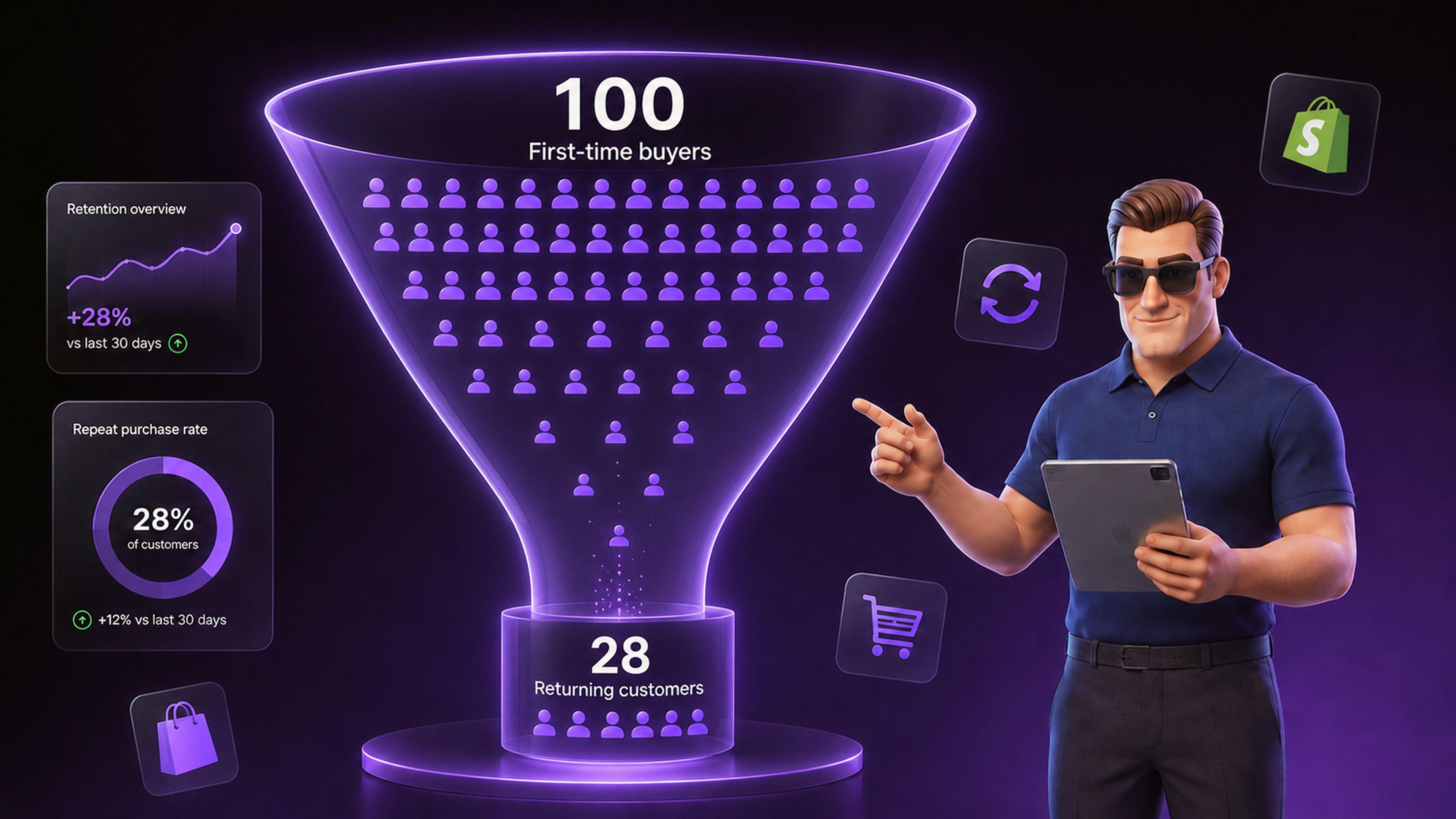
Only 28 percent of first-time buyers on most Shopify stores ever place a second order. That means 72 percent never come back. Combined with customer acquisition costs up 222 percent over the last eight years and an average loss of 29 dollars per new customer, retention has become the single highest-leverage growth lever in DTC commerce. The five retention levers worth pulling first are the post-purchase email sequence, the second-order incentive, product education, the loyalty program structure, and SMS layered onto email. Top-decile Shopify Plus stores hit 40 percent or higher repeat purchase rate by doing all five together.
The 72 percent problem is the core retention failure mode of DTC ecommerce in 2026. Across categories, across price points, across acquisition channels, only 28 percent of first-time buyers ever place a second order. Most never come back. The brands that lose them spend the money to acquire them only to give up the LTV that would have made the acquisition profitable.
Three forces are making this worse year over year. CAC is up 222 percent over the last eight years. Average brand economics now show a 29 dollar loss per new customer because the first-order margin does not cover the acquisition cost. The path back to profitability runs through the second order. Most stores never reach it.
In our work with Shopify Plus stores between 2022 and 2026, we have seen the same pattern repeat. The brands that win are not the ones with the cheapest acquisition. They are the ones that get the highest percentage of first-time buyers to come back.
This post walks through the retention math, the five levers that move it, and the worked example most stores need to see to understand what is at stake.
The 72% problem in plain numbers
Walk through the math with a real-feeling store size.
Picture a Shopify Plus store doing 5 million dollars in annual revenue. The store acquires 50,000 first-time buyers per year. With an industry-average 28 percent repeat purchase rate, 14,000 of those buyers come back for a second order. The other 36,000 never do.
If the average first-order revenue is 80 dollars and the second-order revenue is 90 dollars because returning customers tend to buy slightly more, the store earned 4 million dollars from first orders and 1.26 million dollars from second orders. The cost to acquire those 50,000 buyers at a typical 40 dollar CAC was 2 million dollars. The remaining 740,000 dollars in gross margin contribution is what the store has to fund everything else with.
Now picture the same store with a 40 percent repeat purchase rate, which is the top decile in our data. 20,000 buyers come back instead of 14,000. The store earns an additional 540,000 dollars in second-order revenue with no incremental CAC. Multiply that across the cohort lifecycle, third orders, fourth orders, and beyond, and the difference at scale is millions of dollars of profit.
This is why retention is the single highest-leverage area of growth in 2026 ecommerce. The cost to acquire is sunk. The cost to retain is fractional. The math compounds.
Apply the math to your own numbers and the loss is usually meaningful.
Take any Shopify Plus store. Multiply annual first-time buyers by 28 percent to get current returning customers. Multiply by 40 percent (the top-decile benchmark) to get the potential returning customers. The difference is the population of customers who could have come back but did not.
Multiply that difference by your average second-order revenue. That gives you the immediate revenue you are losing.
Then multiply by the average customer lifetime value uplift from a second order, typically three to five times the first order. That gives you the long-term revenue you are losing.
For most Shopify Plus stores in the 5 million to 50 million dollar annual revenue band, the answer comes out to between 500,000 dollars and 5 million dollars in annual revenue left on the table. The number is large because retention compounds.
Across hundreds of customer interviews and behavioral data sets we have analyzed across client engagements, five reasons explain the bulk of first-time buyer churn.
First is product-related disappointment. The product did not match the marketing. The quality did not justify the price. The fit was wrong. This is a product problem and email cannot fix it. Address it through better product pages, sizing guides, and return policy clarity.
Second is delivery-related friction. The package arrived late, broken, or missing items. The unboxing experience underwhelmed. Customer service failed to resolve a delivery issue. Fix this through better operations, better post-purchase communications, and faster service response.
Third is brand forgetting. The customer enjoyed the purchase but forgot about the brand. They did not enter any email sequence. They never received a post-purchase communication that re-engaged them. The brand fell out of consideration as the next purchase window approached. This is the email and SMS problem. The fix is the retention infrastructure we walk through in our repeat purchase post.
Fourth is price sensitivity. The first order was at a discount or promo price. When the customer comes back at full price, the offer feels worse. They wait for the next promo. Sometimes they never do. Fix this through better loyalty mechanics, member pricing, and value perception that does not depend on the discount.
Fifth is competitor displacement. The customer found a similar product elsewhere, often through a paid ad or social referral. Your brand was not differentiated enough to win the second decision. Fix this through brand storytelling, product differentiation, and the kind of ecommerce personalization that makes the second visit feel personal rather than transactional.
The mix varies by category. The categories overlap and the fixes complement each other.
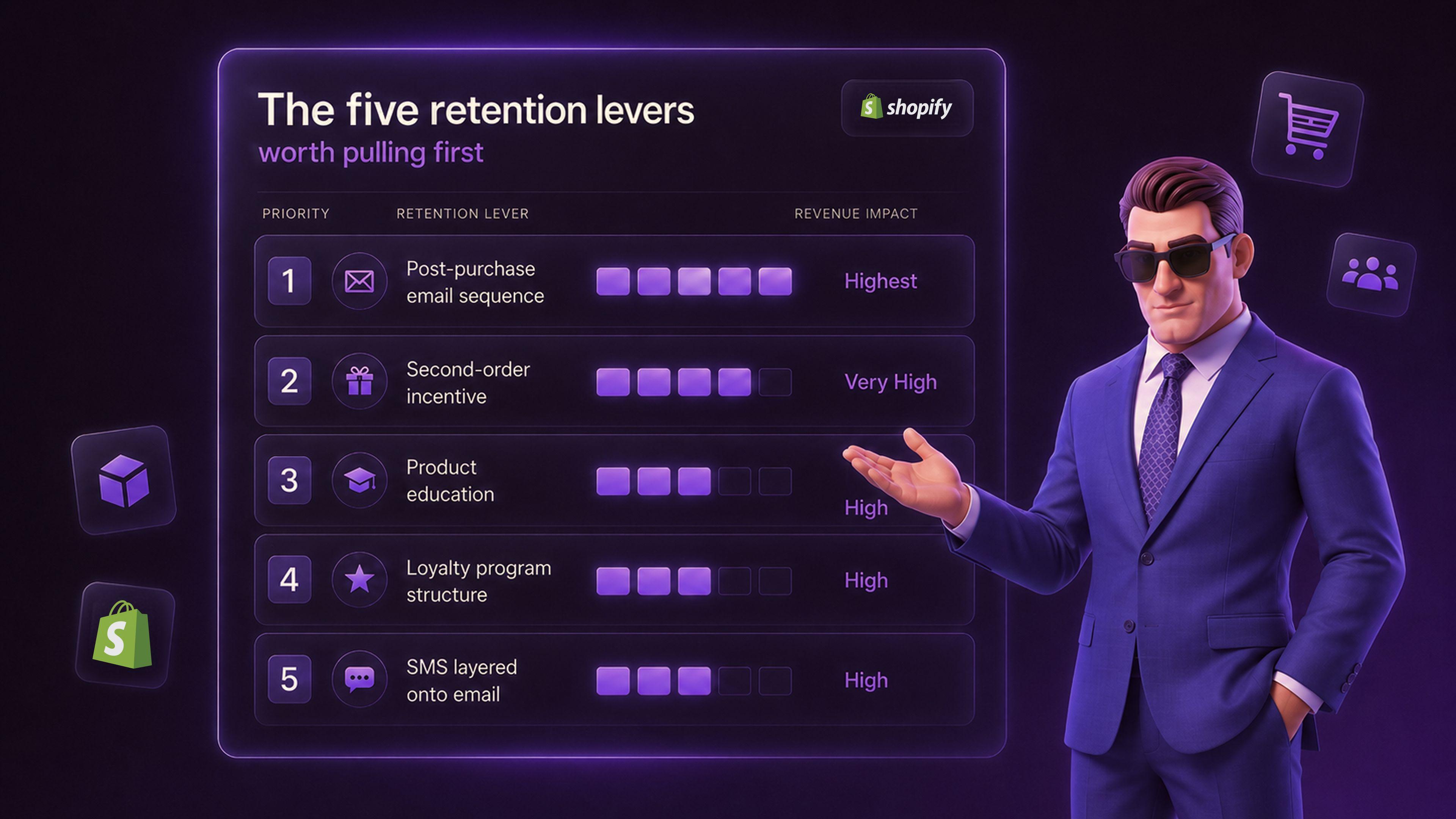
Stores that move from 28 percent to 40 percent repeat purchase rate are not doing one thing. They are doing five things together. Below are the levers in priority order.
Lever one is the post-purchase email sequence. Every first-time buyer should enter a sequence that runs at least 30 days post-purchase. The sequence covers thank you, delivery confirmation, product education, review request, cross-sell, and loyalty enrollment. Most stores run two or three emails and stop. The full sequence earns roughly twice as many repeat purchases as the abbreviated version.
Lever two is the second-order incentive. First-time buyers respond to a clear reason to come back. The most effective incentives are free shipping on the second order, loyalty point multipliers for early repeat purchase, or a small fixed discount that expires within 30 days. The expiration matters. Open-ended incentives produce open-ended delays.
Lever three is product education. Returning customers who understand how to use the product they bought tend to buy more of it. Educational content like how to care for the product, recipe suggestions for food, styling guides for fashion, application tutorials for beauty, drives more incremental orders than purely promotional content does. Build the education into your post-purchase flow.
Lever four is loyalty program structure. Stores that operate a loyalty program with tiered benefits, redemption mechanics that feel meaningful, and member-only product drops earn higher repeat purchase rates than stores that do not. The program structure matters more than the points balance. Pair it with smart product bundling for the highest-impact upsell paths.
Lever five is SMS layered onto email. SMS in Klaviyo or your ESP of choice converts at three to five times the rate of email on transactional triggers. Stores running SMS post-purchase, restock alerts, and shipping notifications consistently earn higher repeat purchase rates than email-only stores. The setup cost is real because of TCPA in the US and GDPR in the UK. The upside is real too.
The top decile of Shopify Plus stores by repeat purchase rate share four habits.
The first habit is treating the first 60 days post-purchase as the highest-value period in the customer relationship. Their flows are designed around it. Their creative is tuned for it. Their team measures it weekly.
The second habit is investing in product education content that compounds. They have how-to videos, written guides, recipe collections, or use-case content that gets reused across email, SMS, social, and the on-site experience. The content does double duty as retention infrastructure and brand-building asset.
The third habit is operating a real loyalty program. Not a points-without-purpose program but a tiered program with member benefits that customers actually want. Early access to drops. Member pricing on hero SKUs. Free shipping at lower thresholds. Category-relevant perks.
The fourth habit is measuring retention at the cohort level rather than the aggregate level. They know the 30-day repeat rate, the 60-day repeat rate, and the 90-day repeat rate by acquisition channel and creative cohort. When a cohort underperforms they investigate why before it compounds.
For Shopify Plus stores with a meaningful B2B revenue stream alongside DTC, the retention math is even sharper. B2B accounts that order quarterly carry vastly higher LTV than DTC one-time buyers, and the playbook sits on different mechanics. Our Shopify features for BFCM sale post covers some of the merchant configuration that supports B2B retention during peak windows.
The infrastructure for retention is well-defined on Shopify Plus in 2026. The components are knowable. The integration patterns are knowable. The cost is roughly the same across stores. What varies is execution.
Start with email and SMS through Klaviyo, Attentive, or your ESP of choice. These platforms handle the segmentation, the conditional flows, and the SMS layering. Klaviyo is the most common choice for Shopify Plus because of the depth of Shopify integration. The marketing automation work we do for Shopify Plus clients centers on this layer.
Add subscription functionality through Recharge, Skio, Bold, or Shopify's native Subscriptions app for categories that fit. Subscriptions are the single highest-retention product configuration. Once a customer subscribes, the second order is automatic.
Add a loyalty program through LoyaltyLion, Smile.io, Yotpo, or your loyalty platform of choice. The platform choice matters less than the program design. Tiered, meaningful, with real benefits.
Add reviews through Trustpilot, Judge.me, Yotpo, or your review platform of choice. Reviews drive both first-time conversion through social proof and repeat purchase through the post-purchase review request flow.
For UAE-based merchants serving Arabic-speaking customers, layer the right BNPL infrastructure including Tabby and Tamara for the regional payment preference. Repeat purchase patterns in the UAE differ from the US and UK, and BNPL plays a larger role in second-order conversion.
The combined stack costs 500 dollars to 3,000 dollars per month for a mid-market Shopify Plus store. The retention lift is typically worth 10 to 50 times that monthly cost when run well.
The biggest measurement mistake is reporting aggregate repeat purchase rate without segmenting by cohort. Stores that look at "what percentage of all customers placed a second order this year" miss the timing dimension entirely.
Use cohort-based measurement instead. Group customers by acquisition month. Track the percentage of each cohort that placed a second order within 30, 60, 90, 180, and 365 days. This shows where retention is improving or declining, by cohort, with the timing visible.
Track repeat purchase rate by acquisition channel. Paid social cohorts often have lower retention than organic search cohorts. Discount-driven cohorts often have lower retention than full-price cohorts. Knowing the segmentation is what makes retention investment actionable.
Track customer lifetime value across acquisition windows. The LTV measurement at 90 days predicts the LTV measurement at 365 days roughly within 20 percent. This lets you measure retention impact without waiting a full year.
Watch out for survivorship bias. If you only measure repeat purchase rate among customers who are still on your list, you exaggerate retention. Always measure against the full cohort, including customers who unsubscribed or churned.
For the GEO-side of measuring how AI-driven discovery affects retention, our GEO foundation for AI visibility on Shopify covers the discovery layer that determines whether returning customers find you through AI assistants on their second purchase intent.
Take a Shopify Plus store doing 10 million dollars in annual revenue. It acquires 100,000 first-time buyers per year. Average first-order revenue is 100 dollars. Industry-average 28 percent repeat purchase rate. CAC is 35 dollars.
Current state numbers. First-order revenue is 100,000 buyers times 100 dollars, which equals 10 million dollars. Repeat customers number 28,000. Average second-order revenue is 110 dollars because returning customers spend slightly more. Second-order revenue is 28,000 times 110 dollars, which equals 3.08 million dollars. Total revenue from this cohort is 13.08 million dollars. Acquisition cost is 100,000 times 35 dollars, which equals 3.5 million dollars.
Target state at 40 percent repeat purchase rate. First-order revenue is unchanged at 10 million dollars. Repeat customers number 40,000. Second-order revenue is 40,000 times 110 dollars, which equals 4.4 million dollars. Total revenue from this cohort is 14.4 million dollars.
Difference is 1.32 million dollars in annual revenue from moving repeat purchase rate from 28 percent to 40 percent. With no incremental CAC. With the same first-order acquisition machinery.
That is one cohort over one year. The compounding effect across multi-order LTV is where the math gets larger. The same 12 percentage point improvement in retention drives a 30 to 50 percent improvement in 36-month LTV in our experience.
Now look at the inverse. A store that drops from 28 percent to 20 percent retention, which happens when retention infrastructure is neglected, loses 8,000 second orders, 880,000 dollars in annual second-order revenue, and a substantially larger long-term LTV gap.
Retention is the lever. The math is the proof.
The 28 percent figure comes from cross-industry DTC benchmarks published across 2024 and 2025 by Swell, Ringly, and other DTC retention research firms. The figure is an average across categories. Subscription-heavy categories run higher at 40 to 50 percent. High-AOV one-time-purchase categories run lower at 15 to 20 percent.
Moving from 25 to 30 percent to 35 to 40 percent repeat purchase rate within 12 months is realistic for most Shopify Plus stores that invest in the five retention levers covered above. Above 40 percent requires category fit (subscription-heavy or replenishment-heavy categories) plus disciplined infrastructure work.
Six months minimum for the full effect because retention is a lagging metric. The post-purchase flows you build today drive the second orders six months from now. Patience is part of the work.
For stores past 1 million dollars in annual revenue, yes. Below that threshold the operational cost of running a loyalty program often outpaces the benefit. Above it, the lifetime value lift on enrolled customers typically justifies the platform cost and creative investment.
For categories that fit, subscriptions are the strongest single retention lever available. Subscription customers carry 5 to 10 times the LTV of one-time buyers in our experience. But subscription pricing has to fit the category. Selling subscription on durables like electronics, furniture, or high-AOV fashion does not work the way it works on consumables.
UK retention math is similar to US, with slightly higher baseline repeat purchase rates because UK consumer behavior includes more brand loyalty on average. UAE retention math is higher again because customer acquisition costs are lower (Arabic-language paid social is less competitive than English) but average order values run smaller. The lever priority shifts slightly toward subscription and loyalty mechanics in the UAE.
Sending the same post-purchase email sequence to every customer regardless of category, AOV, or behavior. Segmentation by purchase category and customer profile lifts post-purchase flow revenue 30 to 50 percent in our experience. Most stores skip this and treat all first-time buyers the same.
Both. But retention has a higher ROI per dollar invested because the acquisition cost is sunk. For most Shopify Plus stores past 2 million dollars in annual revenue, the ratio of retention investment to acquisition investment should be roughly 30/70 or 40/60. Most stores under-invest in retention closer to 10/90.
The 72 percent problem is not a small problem. It is the single largest revenue leak in DTC ecommerce in 2026. Stores that fix it earn millions of dollars in incremental annual revenue with no incremental CAC. Stores that ignore it slowly bleed margin until the unit economics fail.
The infrastructure to fix it is well-defined. The investment is small relative to the upside. The execution is consistent across stores. Most stores do not do it because retention is patient work and acquisition is the addictive lever.
If you are a Shopify Plus merchant scoping a retention overhaul, our Shopify Plus retention and CRO team runs these engagements regularly. We typically identify the three to five highest-leverage gaps in a half-day audit and recommend the build sequence to close them.

Drop your details and we'll email the download link straight to your inbox.