




E-Commerce•13 Min
A Safe Shopify Go-Live Checklist: Backups, Theme Sync, and Zero-Downtime Deploys

Written byRishi Thacker
Posted onOct 08, 2026



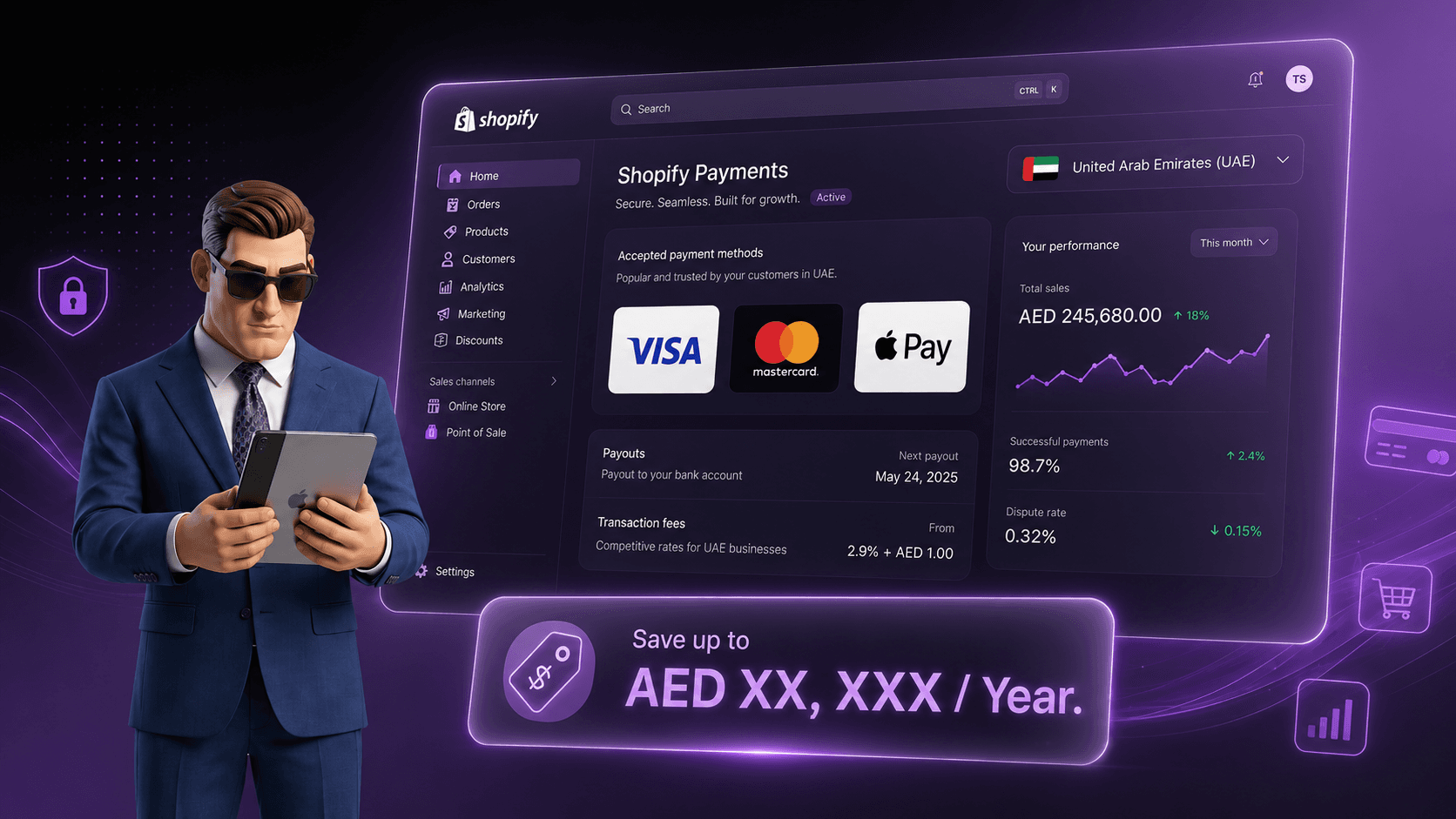
You run a Shopify store in the UAE. Every order pays a third-party gateway like Telr or PayTabs around 2.5 to 2.9 percent. And on top of that, Shopify quietly charges an additional 0.5 to 2 percent transaction fee just for using a third-party processor.
Most UAE merchants have been paying this fee for years and never run the math.
That's about to change. Shopify Payments is now in early access for UAE merchants, and it removes the additional Shopify transaction fee entirely. For a store doing AED 100,000 a month, the saved fee can run into thousands of dirhams every month. Over a year, that adds up to real money you could be reinvesting into product, marketing, or hiring.
This post walks through what just shipped, what it actually supports, the real cost math, who qualifies, and what your full UAE payment stack should look like now that Shopify Payments is on the table.
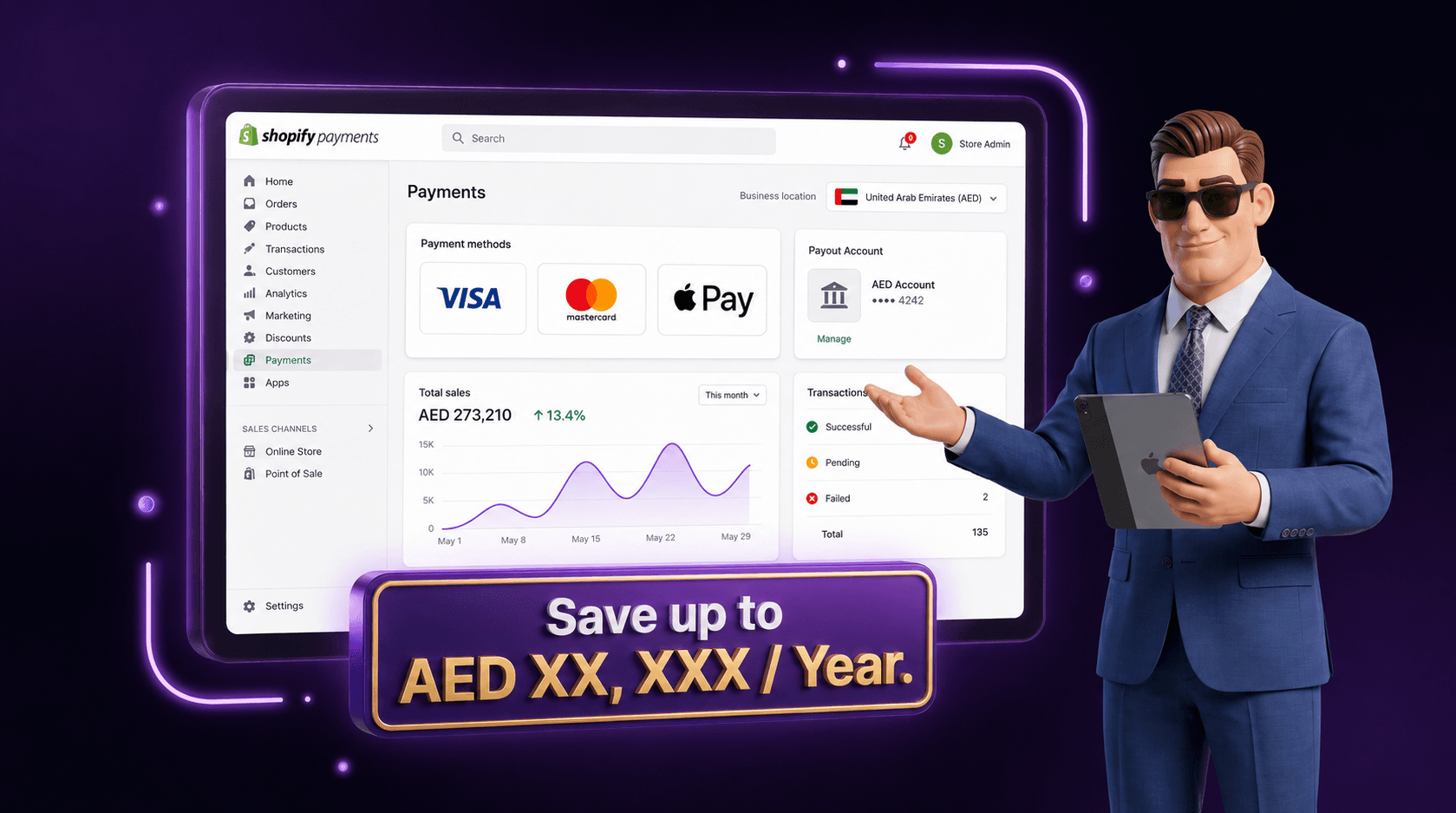
Yes, in early access. Shopify Payments launched for UAE merchants in 2026 and is currently available only to selected stores, not all UAE merchants. The early access version supports credit and debit cards (Visa, Mastercard) plus accelerated checkout (Apple Pay, Google Pay, Shop Pay) in AED. BNPL providers like Tabby and Tamara still require their own Shopify apps.
For years, UAE Shopify merchants had no native Shopify Payments option. Every store had to plug in a third-party gateway: Telr, PayTabs, Tap Payments, Checkout.com, Network International, or Amazon Payment Services. The gateway handled card processing. Shopify still charged an additional transaction fee on every order on top of that, ranging from 0.5 percent on the Advanced plan to 2 percent on the Basic plan.
That additional fee is the cost most UAE merchants underestimate. On a store processing AED 100,000 a month on the Basic plan, the 2 percent additional fee alone is AED 2,000 a month. Or AED 24,000 a year. Paid for nothing the merchant could see or control.
Shopify Payments early access changes the equation. When a merchant runs payments through Shopify Payments, the additional 0.5 to 2 percent transaction fee disappears. The merchant pays Shopify Payments' own processing rate (a single, all-in cost) and nothing else from Shopify on top.
The early access program is not generally available. It rolls out in waves. Eligibility shows up inside the Shopify admin under Settings, Payments. If your store qualifies, you'll see Shopify Payments listed as an activation option. If it doesn't yet, you'll continue running your current gateway.
The early access version of Shopify Payments UAE supports the core card and wallet stack.
Confirmed payment methods:
Settlement currency is AED. Payouts route to your registered UAE business bank account.
What is not included natively in Shopify Payments UAE:
The right way to think about Shopify Payments UAE is as the card-and-wallet layer of a multi-layer stack. It handles the highest-volume payment type cleanly and at a lower total cost, while the rest of the stack continues to handle BNPL, COD, and multi-GCC routing.
The fee savings are the strongest reason to act on Shopify Payments early access.
Here is the worked example for a UAE merchant processing AED 100,000 a month on the Basic Shopify plan ($39 a month) using Telr as the current gateway:
| Cost Component | Current Stack (Basic + Telr) | New Stack (Basic + Shopify Payments) |
|---|---|---|
| Shopify subscription | $39 / month | $39 / month |
| Gateway processing | Telr at ~2.9% = AED 2,900 | Shopify Payments at ~2.9% = AED 2,900 |
| Shopify additional fee | 2% = AED 2,000 | Waived |
| Total monthly processing | AED 4,900 (4.9% effective) | AED 2,900 (2.9% effective) |
| Monthly savings | AED 2,000 | |
| Annual savings | AED 24,000 |
The pattern holds across plan tiers, with different magnitudes:
The savings logic is consistent: the higher your plan tier, the smaller the additional fee, and the smaller the absolute saving from switching. But for the largest segment of UAE Shopify merchants (Basic and Shopify plan brands doing AED 50,000 to AED 500,000 a month), the math is meaningful.
[VERIFY] Shopify has not yet published a public UAE rate card at the time of writing. Mature-market Shopify Payments rates typically sit around 2.9 percent plus a small fixed fee for online card transactions, lower on higher plan tiers. Confirm the actual rate displayed in your Shopify admin before running internal projections.
Eligibility for the early access program follows Shopify's standard payment-processor requirements, adapted for the UAE.
What you need:
Shopify has not published a public eligibility list naming specific business sizes, categories, or emirates. The Shopify admin shows whether your individual store qualifies. Some merchants will see the Shopify Payments option appear; others won't. There is no public waitlist URL at the time of writing.
If your store doesn't currently qualify, the most useful actions are to make sure your underlying setup is clean: TRN registered and active, business bank account in good standing, all KYC documents current, and your Shopify business address matching your trade license. Then re-check eligibility every few weeks.
The activation flow is the standard Shopify Payments onboarding path with UAE-specific verification steps.
Step by step:
Review typically takes a few business days, though early access programs in other markets have shown faster turnarounds. You'll receive an email confirmation when Shopify Payments is approved and ready to process.
Once approved, test the checkout flow with a low-value real transaction before disabling your current gateway. Confirm 3D Secure 2.0 works correctly with at least one UAE-issued Visa and one Mastercard, that Apple Pay surfaces on mobile, and that the payout to your UAE bank lands correctly.
Not every UAE merchant should switch immediately. The decision depends on what your current stack does and what your customer base actually needs.
Three honest scenarios:
Switch fully. Single-market UAE-focused stores with no COD volume, no multi-GCC selling, and no enterprise-negotiated gateway rates. The math is clean. Shopify Payments handles cards and wallets at lower total cost. You disable your old gateway, save the additional fee, and simplify the stack. This fits most growing DTC brands doing AED 50,000 to AED 500,000 a month.
Switch primary, keep secondary. This is the right answer for most growing UAE brands. Shopify Payments becomes the primary card and wallet processor. You keep Tabby and Tamara active via their Shopify apps for BNPL. You keep PayTabs or Telr active for any multi-GCC routing or COD volume. Customers see all options at checkout, and you optimize each layer independently.
Don't switch yet. Stay on your current gateway if you have enterprise-negotiated rates with Network International or Checkout.com that beat Shopify Payments' published rate. Or if your category is COD-heavy and the relative savings from a card-only switch are marginal. Or if you need niche payment methods (mada, KNET, Benefit) that Shopify Payments doesn't cover. For brands moving from a non-Shopify platform into the UAE Shopify ecosystem at the same time, we cover the cleaner sequencing inside our platform migration services.
The decision is not a one-way door. You can run Shopify Payments alongside a third-party gateway and route traffic deliberately. The merchants who get this right run the unit economics on their actual SKU mix and customer geography, not on what their previous-quarter playbook said. We work through this exact decision with brands inside our strategy for emerging brands engagements.
Be clear about what early access doesn't include. Some of these gaps still need separate work.
The headline win is real, but the rest of the operational reality stays the same.
The right stack for the typical UAE Shopify brand in 2026 has four layers, each owning a specific job.
Layer 1: Cards and wallets. Shopify Payments if eligible. Tap Payments, Telr, or Checkout.com if not eligible yet. This layer handles the highest volume of transactions.
Layer 2: BNPL. Tabby and Tamara, installed via their respective Shopify apps. Most growing UAE brands run both because they reach slightly different customer segments. Setup is roughly an hour total.
Layer 3: Cash on Delivery. Native Shopify COD or a COD app, typically with order-value caps to manage risk. UAE COD volume is still significant, especially outside major cities.
Layer 4: Multi-GCC (conditional). PayTabs or Telr handling mada, KNET, and Benefit if you sell into Saudi Arabia, Kuwait, or Bahrain. If you're UAE-only, skip this layer.
Most UAE merchants we audit at Huptech run three of these four layers actively, with the fourth conditional on geographic footprint. The early access window is the right time to revisit the stack as a whole, not just swap one gateway for another.
For brands at higher transaction volumes, the architecture decision often pairs with broader Shopify Plus development work where checkout customization, B2B flows, and multi-region pricing matter. The same logic applies to brands evaluating wholesale expansion, where the channel-mix question we covered in our Shopify B2B wholesale guide extends naturally into payment-stack design.
The patterns we see when brands switch payment stacks in a hurry:
Shopify Payments entered early access in the UAE in 2026. It is currently available to selected merchants only, not the general Shopify population in the UAE. The official help page at help.shopify.com confirms the early access status. Shopify has not published a general availability date. Merchants can check eligibility for their store in the Shopify admin under Settings, Payments.
Shopify has not yet published a public UAE rate card at the time of writing. Standard Shopify Payments rates in mature markets sit around 2.9 percent plus a small fixed fee per online card transaction, with lower rates on higher plan tiers. The bigger savings come from eliminating the 0.5 to 2 percent additional Shopify transaction fee that applies when merchants use third-party gateways. Confirm current rates in your Shopify admin.
Yes, and most growing UAE brands should. Shopify Payments handles credit and debit cards plus accelerated checkout (Apple Pay, Google Pay, Shop Pay). Tabby and Tamara handle BNPL, which Shopify Payments does not include natively. Run them as parallel layers: Shopify Payments for card and wallet checkout, Tabby and Tamara via their Shopify apps for split-payment options. Customers see all options at checkout.
Yes. Standard Shopify Payments requirements apply: a UAE-registered business entity, a UAE business bank account, a Tax Registration Number (TRN) from the Federal Tax Authority, and KYC documentation including Emirates ID, trade license, and proof of address. Both mainland trade licenses and free-zone licenses qualify in most cases. Confirm specifics with Shopify support during onboarding.
Yes. Shopify Payments UAE includes accelerated checkout, which covers Apple Pay, Google Pay, and Shop Pay. Apple Pay adoption in the UAE is very high, and enabling it natively reduces mobile checkout friction. Shop Pay is also useful for cross-border buyers who already have Shop Pay accounts. Configuration is automatic once Shopify Payments is activated; you do not need a separate Apple Pay merchant account.
You continue using your current third-party gateway (Telr, PayTabs, Tap, Checkout.com, Network International, or similar) and pay Shopify's additional 0.5 to 2 percent transaction fee. While waiting, make sure your business setup is clean: complete TRN registration, ensure your business bank account is in good standing, and keep KYC documents current. Re-check eligibility in the Shopify admin every few weeks. Shopify typically expands early access in waves.
Shopify Payments UAE early access is the first time UAE Shopify merchants have had a native, lower-fee path through Shopify's own processor.
The headline win is real and immediate. Recovering 0.5 to 2 percent on every order isn't a marginal feature improvement. For a brand doing AED 100,000 a month on the Basic plan, it's AED 24,000 of recovered margin a year. That money funds an extra hire, a marketing test budget, or just better unit economics on every order.
The deeper story is what it signals. Early access today usually means general availability in 6 to 18 months, and Shopify clearly views MENA as a market worth investing in. The merchants who set up correctly during early access have a cleaner runway than the ones who patch it in later under time pressure.
If you qualify, activate. If you don't yet, fix the underlying setup so you qualify in the next wave. Either way, this is the right moment to audit your full UAE payment stack and decide what the next 12 months should look like.
The brands that win UAE ecommerce next aren't the ones with the most apps. They're the ones with the cleanest stack.
At Huptech Web, we help UAE Shopify merchants design payment stacks that match their actual SKU mix, customer geography, and growth plan. That includes Shopify Payments onboarding, hybrid stack design with Tabby and Tamara, COD and multi-GCC routing, the unit-economics review that tells you whether your current plan tier is right, and the SEO and GEO targeting work that captures the UAE demand once the checkout is sorted.
If your UAE store is processing real volume and you want a stack that compounds rather than leaks, start with a conversation about your current setup and where the highest-ROI fix lives.

Drop your details and we'll email the download link straight to your inbox.