


E-Commerce•10 Min
Replatform or Optimize? A Decision Framework for Ageing Ecommerce Stores (2026)

Written byRishi Thacker
Posted onSep 16, 2026



Most Shopify brands know exactly how much they spend getting people to their store.
Google Ads. Meta. Influencers. SEO. Email. Retargeting. But there is another number very few brands know:
One finds a product they like and leaves. One adds $200 worth of products to their cart and gets distracted. One checks a sold-out product and never comes back to see that it was restocked.
One likes what they see but isn't ready to hand over an email address or phone number yet. A browser notification is easy to dismiss.
It appears for a few seconds, takes up almost no space, and usually contains fewer words than the first paragraph of an email.
It doesn't look like a serious revenue channel. That is probably why so many Shopify stores barely think about it.
We did.
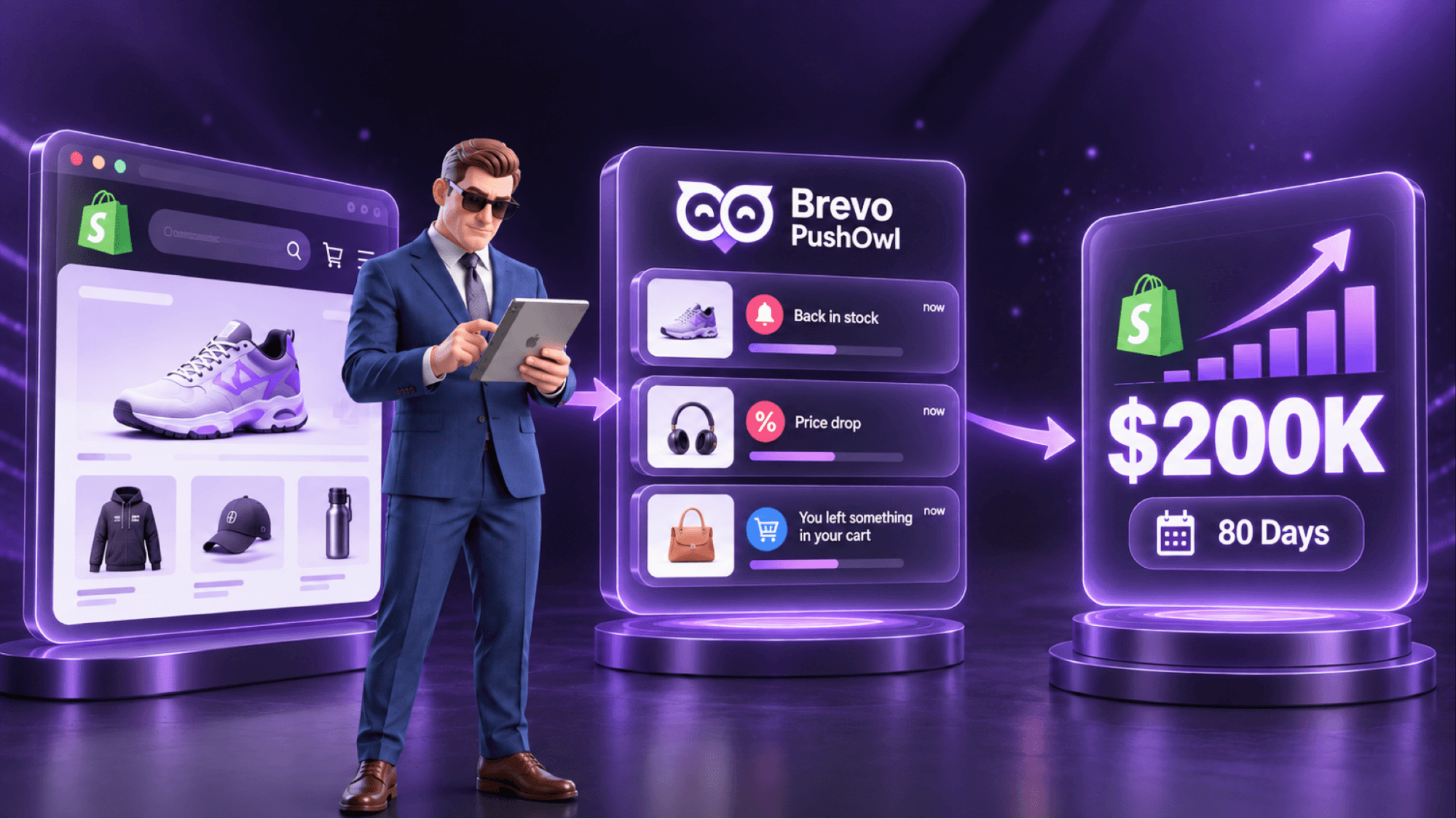
And over 80 days, one Shopify store generated more than $200,000 in PushOwl-attributed revenue from web push notifications.
The numbers behind it were just as interesting:
| RESULT | 80-DAY PERFORMANCE |
|---|---|
| PushOwl-attributed revenue | $200K+ |
| Push subscribers | 6,470 |
| Click rate | 8.12% |
| Conversion rate | 5.9% |
No giant new advertising budget drove that $200K figure. No additional email list generated that attributed revenue. No SMS campaign did it.
No single notification that suddenly went viral and carried the entire result.
The store simply found another way to stay close to people who were already interested in buying, and then used that opportunity consistently.
For Shopify brands spending heavily to attract attention, that is where this story gets interesting.
Because sometimes the next big growth opportunity isn't getting more people to your store. It's doing more with the people already coming to it.
There was something unusual about the store behind this result.
It wasn't a small business desperately trying to find traffic.
The store was already generating millions in revenue. People knew the products, customers were actively searching for them, and SEO was bringing shoppers to the website.
But this wasn't an ordinary ecommerce category.
The business was operating in the kratom and 7-hydroxymitragynine market.
That meant many of the usual options available to a Shopify brand weren't available in the same way here.
A fashion brand can decide it wants more customers and increase its Meta budget. A furniture brand can put more money into Google Shopping. A beauty brand can build a larger paid campaign around its next launch.
Businesses selling products covered by major advertising platforms' restrictions around recreational drugs and psychoactive substances face a very different reality.
So organic search mattered enormously.
People had to discover the store. Read. Compare. Choose. And once somebody arrived, that visit carried more weight.
Before getting into exactly how it worked, the numbers were worth understanding.
Instead of constantly asking, “How do we find another customer?” we built a system that also asked:
“How do we stop losing the customer who is already here?”
That is where this story really starts.
A $200K headline looks great.
But a revenue number means very little without understanding what happened underneath it. The other numbers are what make this case interesting.
That is the number that makes you stop scrolling.
More than $200,000 in revenue was attributed to PushOwl over the 80 days.
A distinction is important. Installing an app doesn’t magically create $200K of completely new demand.
What the system did was create more opportunities to turn that existing attention back into store visits and purchases.
And that is precisely why this channel can be so valuable.
Acquiring demand is expensive. Capturing more of the demand you already have can be a very different equation.
And once enough of those moments started adding up, a small notification stopped looking so small.
In the same 80 days, the store built a base of 6,470 push subscribers.
This was important because not every visitor wants another newsletter. Not everybody wants to hand over a phone number. But some shoppers are perfectly happy to receive a short browser notification when something useful happens.
That gave us another group of customers we could communicate with without depending entirely on email or SMS.
And unlike a one-off campaign, the audience kept growing.
PushOwl's published web push benchmark lists a 3.68% average CTR for web push campaigns, based on data it compiled from 90 Shopify Plus stores. Its same benchmark lists 7.4% for abandoned-cart reminders and 5.79% for browse-abandonment notifications.
This store's 8.12% overall result was therefore not something we treated casually.
But the lesson isn't:
“Write crazier headlines.”
It is almost the opposite. Most of the time, shoppers don't need to be clever. They need a reason.
Why should I care about this right now?
There is very little room inside a push notification.
That forces the strategy to become sharper. No long introduction. No beautifully designed newsletter before the point finally arrives.
You either have a reason to earn the click…
Or you don't.
Clicks are not the finish line.
A notification can generate curiosity all day and still make very little money if the traffic does not convert.
During the measured period, traffic coming through these notifications converted at 5.9%. That matters more than the click rate. Because web push can get one through the door again.
This is where web push stops being merely an “engagement channel.” Because the goal wasn't to make notification analytics look impressive.
The goal was revenue. The push gets the shopper back. The Shopify store still has to finish the job. Product. Price. Offer. UX. Trust. Speed. Checkout.
All of it still matters.
Which is why we never look at web push in isolation. A notification can reopen the door.
Your store still has to make the sale.
You've almost certainly seen one.
A small notification appears on your desktop or phone.
That's web push.
A visitor lands on your Shopify store and chooses to allow notifications through a supported browser or device.
There are no long layouts to design. No giant newsletter. Very little room for explanation. That’s partly why the format works.
It forces the store to have something worth saying. A good push notification usually comes down to three things:
That's it.
There are two main ways stores use it.
The first is automation.
Imagine somebody lands on your Shopify store after clicking a Google result.
They find a product they like. They aren't ready to buy yet, but they agree to receive browser notifications. That small action changes what happens next.
One of PushOwl's price-drop workflows, for example, allows an interested visitor to opt into a product's price-drop waitlist. When the product price drops, the notification can be triggered automatically.
That is what makes automation powerful here.
Nobody on your team needs to notice that one specific shopper left one specific cart and manually message them.
The second is a campaign.
The business decides there is something worth announcing, maybe a new release, a genuine offer, or a product update, and sends a notification to the relevant subscribers.
Simple.
But when it happens thousands of times, simple can become very valuable.
One mistake we would not recommend making is replacing your entire retention strategy with push notifications.
Web push doesn't make email irrelevant. It doesn't make SMS irrelevant. They do different jobs.
| CHANNEL | WHERE IT WINS | WHERE IT STRUGGLES |
|---|---|---|
| Longer stories, education, newsletters, launches, detailed product communication | Crowded inboxes and slower attention | |
| SMS | High-urgency communication where immediacy matters | More intrusive and requires phone-number permission |
| Web Push | Fast reminders, behavioural triggers, restocks, price changes, carts and bringing visitors back | Very limited space; every word has to earn its place |
Email can explain the story. SMS can demand attention. Web push can reopen the tab.
None needs to destroy the others. The opportunity appears when each channel has a job.
The mistake is treating every channel as another place to paste the same promotion. Nobody needs the same sale announced by email, text, and browser notification within ten minutes.
Good marketing isn't about being everywhere at once.
It's about using the right place for the right message.
Web push is easy to send.
That is both its advantage and its biggest danger. Once a brand sees that sending a campaign takes minutes, the temptation is to keep sending.
Soon, customers stop seeing useful notifications. They see interruption. And once that happens, the channel loses its value.
After running the channel consistently, a few patterns became very clear.
This sounds obvious, but it eliminates lots of bad campaigns.
The best push notification does not necessarily have the cleverest copy.
Sometimes the strongest message is simply:
“The product you wanted is back.”
The context does most of the selling. The same is true with carts, price drops, and certain launches.
When somebody already cares about the product, your job isn't always to manufacture more desire.
Sometimes your job is just to show up at the right moment.
The less work someone has to do to understand why you're contacting them, the better.
A cart reminder while the product is still fresh in somebody's mind can be useful.
A completely irrelevant notification three weeks later is not the same thing.
PushOwl's browse-abandonment automation is designed around this idea, automatically following up with subscribers who viewed products without adding them to a cart. Its documentation also places limits on how frequently those browse reminders are sent.
That matters.
Because good automation should respond to behaviour.
It should not chase people indefinitely.
A push notification isn't the place for your entire campaign brief.
If it takes three sentences to explain why somebody should click, the message probably isn't clear enough yet.
The notification gets attention. The page after the click can do the explaining.
This is where surprisingly many campaigns fall apart. This sounds obvious. You would be surprised.
If a notification says:
“The jacket you wanted is back.”
The click should not dump the customer onto a generic homepage.
If it says:
“Your cart is waiting.”
Don't make them rebuild the cart. If it promotes one collection, take them to that collection. Every additional step creates another chance to lose the shopper.
Push is not just about the notification.
It is about the entire path after the notification.
PushOwl makes sending easy.
That doesn't mean you should use it every time somebody in marketing thinks of another promotion.
Too many notifications turn into background noise.
Once that happens, the channel loses the thing that made it useful in the first place: attention.
For this account, we preferred having something worth saying over simply having something scheduled to send.
You do not need twenty-seven automations on day one. Start where buying intent already exists.
These are the first five we'd look at.
A shopper wanted something. You couldn't sell it to them.
That is frustrating. But it is also useful information. The shopper has already told you what they care about.
When inventory returns, a back-in-stock push gives you a chance to close the loop.
PushOwl currently supports automated back-in-stock alerts for shoppers interested in products that were previously sold out.
No huge creative concept is required. The product coming back is the news.
For brands with fast-moving inventory, limited drops, popular variants, or frequent restocks, this can turn an operational event into a revenue event.
Sometimes the product isn't the problem.
The price is.
Someone might happily buy at $80 what they passed on at $110.
If the price changes, you now have useful new information for somebody who was already interested.
Imagine looking at a product today and deciding:
“I like it, but not at that price.”
Tomorrow, the price changes. That is information you would probably want.
PushOwl's price-drop automation is built for exactly that moment: interested shoppers can receive a browser notification when the relevant product's price drops.
Flash sales work differently but benefit from the same strength. They are time-sensitive.
When a message loses value six hours later, getting it in front of somebody quickly matters.
The important part is that the urgency has to be real. Real price. Real deadline. Real availability.
Otherwise, short-term clicks come at the cost of long-term trust.
This is where things get difficult to ignore.
PushOwl says around 70% of add-to-carts are abandoned, meaning roughly seven out of ten carts do not become completed purchases. It also reports that subscribers who click its abandoned-cart push notifications convert at approximately 2× the store average.
Read that carefully.
It does not mean web push magically recovers every abandoned cart.
Those are the carts worth fighting for. Because the hardest part has already happened.
Paying for another cold visitor while doing nothing about that shopper makes very little sense.
We recovered $128K from this automation only.
Cart abandonment gets all the attention because the intent is obvious.
But what about the visitor who never reaches the cart?
They land on a product. Look through the photos. Check variants. Maybe come back to the same page twice. Then leave.
No checkout started. No cart created.
But definitely not zero interest.
Browse-abandonment notifications give the store another chance to bring some of those visitors back.
PushOwl's published benchmark lists 5.79% CTR for browse-abandonment notifications, and its current product documentation describes browse abandonment as an automation for subscribers who viewed a product without taking further action.
Again, the point isn't to stalk everybody who looked at a T-shirt.
It is to recognise that behaviour carries information.
And when the information tells you somebody was interested, ignoring it completely can mean leaving an opportunity behind.
Not everything needs a discount.
In fact, if customers only react when you slash the price, you may be training them to wait. Product launches give web push a different job. Create curiosity.
Give people a reason to return.
A simple message that tells the right audience something new has arrived can be enough.
This works particularly well for stores with strong repeat traffic, limited releases, seasonal collections, enthusiast products or customers who actively watch what launches next.
The notification does not need to reveal everything.
Sometimes it should simply make the customer think:
“What's new?”
Then let the collection page do the rest.
There isn’t one. No secret notification template made $200K appear. No “one weird trick.” No daily blast.
What worked was much less exciting:
We built a system and kept running it properly.
Nothing happens without an audience.
So the first job was to ensure the push channel was correctly implemented and giving eligible visitors a sensible opportunity to subscribe.
This is where many brands make their first mistake.
They obsess over the first campaign before they have built meaningful reach.
We cared about the foundation first.
Subscriber acquisition.
Opt-in experience.
Correct setup.
Tracking.
Where the notifications would send people.
Once those pieces were working, every new subscriber increased the potential reach of future campaigns and automations.
You should not activate an automation simply because an app offers it.
You activate it because there is a customer behaviour worth responding to.
PushOwl currently supports automations including abandoned-cart recovery, back-in-stock, price-drop, welcome, and browse-abandonment notifications.
Once those flows are built correctly, they do not wait for Tuesday's marketing meeting.
They respond when the relevant behaviour happens.
That is what makes the model scalable.
We focused on roughly few automated reminders that matched real customer behaviour.
The rule was simple:
If the customer hadn't given us a reason to send the message, we didn't need to create one just because the feature existed.
Before writing campaigns, we looked at what was actually happening in the store.
Was there a real offer? Did a particular product deserve attention?
Was something new launching? Had we already talked about the same thing recently?
What had customers responded to before? Only then did we write.
That meant the calendar didn't decide the campaign. The business did.
This mattered especially for a store operating in a sensitive category.
The product needed to be correct. The link needed to work. The discount needed to be real.
The wording needed to stay within the approved boundaries. And when campaigns touched on regulatory developments, the facts had to be current and precise.
A short copy doesn't permit you to be careless.
In some ways, it demands even more precision.
Alongside the automatic reminders, we generally sent two planned campaigns each week.
That gave us enough room to test ideas and keep the channel active without turning it into a daily interruption.
It also forced better decisions. When you can't send everything, you have to choose what is actually worth sending.
There is a huge difference between:
“It's Thursday. We need to send something.”
and:
“There is something worth telling customers today.”
That difference protects the audience.
And protecting the audience protects the channel.
We don’t immediately forget about it and move to the next one.
We looked at what happened.
Did people click? Did they buy it? Did one type of offer work better than another? Had we started repeating ourselves?
Was there a message style customers clearly responded to?
Those answers shaped what we did next. That's where a tool starts becoming a strategy.
Anyone promising that installing PushOwl will automatically produce $200K for your Shopify store does not know that either.
Your store is different.
PushOwl itself notes that web push performance varies based on strategy, sending frequency, and messaging.
So $200K is not a promise.
It is proof of what became possible in this store, with this traffic, this audience, and this system. But there is a much more useful question you can ask:
And that's usually where we'd begin.
Not by asking:
“Should we install PushOwl?”
But:
“Would push actually have enough useful work to do on this store?”
That's a much better question.
This is the part we want Shopify brands to take away from the entire case.
$200K wasn't hiding inside a push notification app.
It was sitting inside thousands of customer moments. The cart somebody almost bought. The product somebody wanted. The browser session somebody abandoned. The restock somebody never knew happened. The launch a previous visitor might have cared about.
Push gave us a way to act on more of those moments.
Strategy turned that ability into a system. And the system turned attention that could have disappeared into measurable revenue.
That's the opportunity.
Not “more notifications.”
More revenue from demand you already worked hard to create.
If your Shopify store gets traffic but you don't know how much of that demand is quietly disappearing every day, that is exactly the kind of problem we work on at Huptech Web.
And then we determine where the revenue gaps actually are.
Because maybe web push is one of them. Maybe it isn't.
Either way, we'd rather find the opportunity before you throw another dollar at acquiring traffic you already know how to attract.
Want to know what your existing Shopify traffic could be doing better? We look for the revenue your store might already be earning, but isn't capturing yet.
Start a Conversation with Huptech Web →
Shopify web push notifications are short browser or device notifications sent to shoppers who have opted in to receive them. Stores can use them for promotional campaigns and behaviour-based messages.
Unlike a traditional email signup, web push itself does not require the shopper to provide an email address. Support and delivery can vary depending on the browser and device being used.
PushOwl is a Shopify marketing platform that supports web push notifications alongside other communication features. Its web push tools include campaigns, subscriber management, and automations for abandoned carts, back-in-stock alerts, price drops, welcome notifications, and browse abandonment.
For Shopify merchants, that makes it possible to run both scheduled campaigns and notifications triggered automatically by customer behaviour.
No email address is required for a shopper to subscribe specifically to browser push notifications. PushOwl describes its web push opt-in as a one-click method of reaching subscribers without requiring email or SMS permission.
That is one reason push can complement email rather than simply duplicate it.
They can contribute to sales when the store has enough relevant traffic, subscribers, and well-designed campaigns or automations.
They should not be treated as guaranteed revenue. Results depend on the audience, products, offer, timing, frequency, landing experience and overall conversion performance of the Shopify store.
There isn't one perfect number. For this store, we generally ran two planned campaigns each week, with automatic reminders working separately. The more useful rule is to send when there is a genuine reason to contact the customer.
The better rule is not “send X times.” It is: Have a reason every time you send.
No. They do different jobs. Email gives you more space. SMS is useful when speed matters. Push works particularly well for short reminders and timely updates.
The result in this case depended on the store's traffic, customers, products, subscriber base, campaigns, conversion rate, and overall setup. The better question is whether your store already has enough customer activity for web push to become commercially worthwhile.
Yes. We can help with the setup, automatic messages, campaign planning, copy, sending frequency, links, reporting, and ongoing improvements. More importantly, we can first determine whether web push is actually worth pursuing for your store. Because the goal isn't to add another app.
It's to find another source of revenue.

Drop your details and we'll email the download link straight to your inbox.