




E-Commerce•12 Min
Shopify Search & Filtering: Algolia vs the Cheaper Alternatives (a Cost & Feature Breakdown)

Written byRishi Thacker
Posted onOct 28, 2026



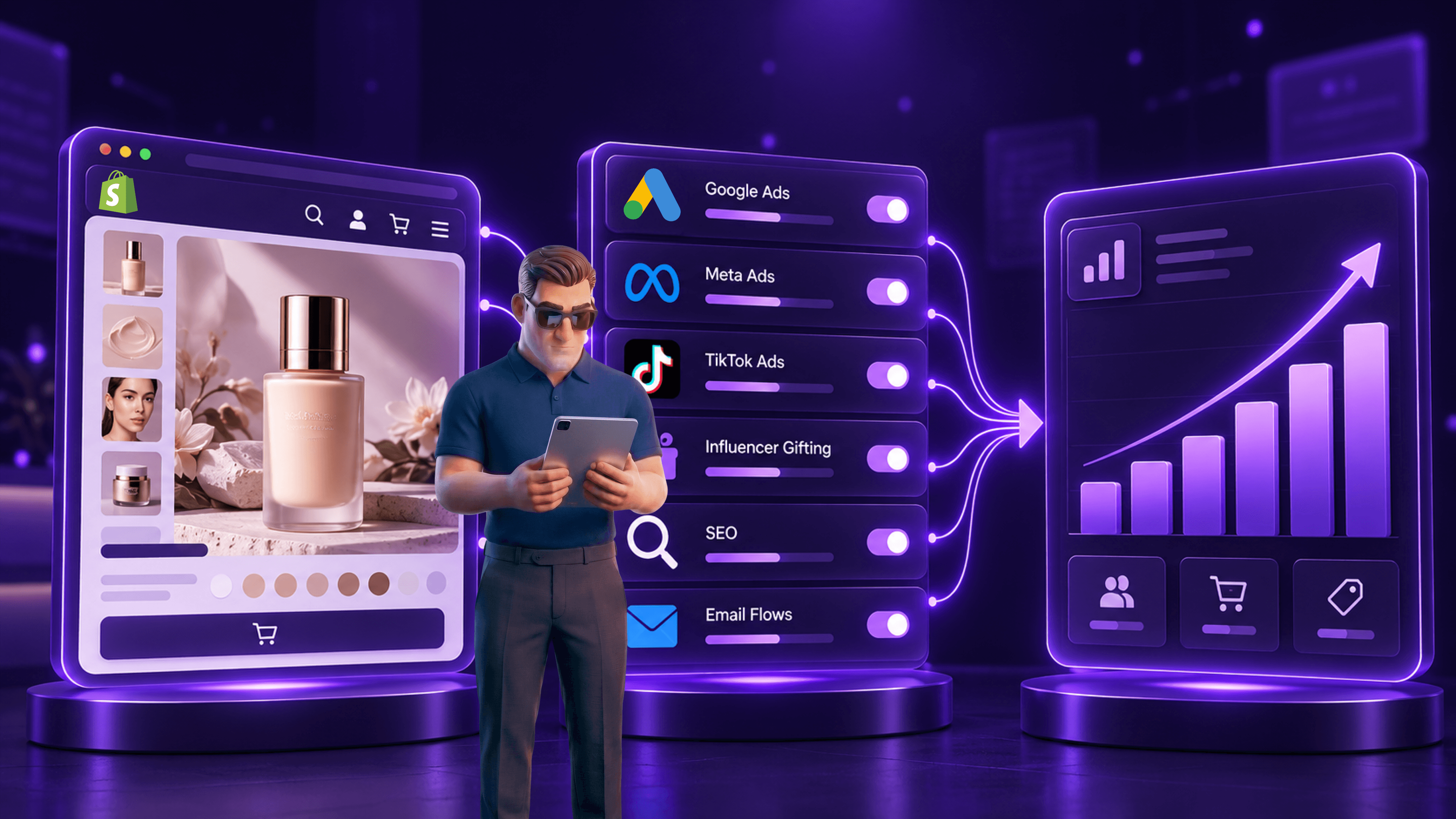
Your beauty store doesn't have a traffic problem. It has a leak.
You're already paying for the visitors.
Google Ads. Meta. TikTok. Influencer gifting. SEO. Email flows.
Traffic is arriving at the store. Hundreds of sessions a day. Sometimes thousands around a launch or a sale.
The problem isn't that nobody is visiting.
The problem is that most of them are leaving without buying.
That gap between visitor and buyer is where almost every beauty brand loses the most money. Not in acquisition. In the store itself.
A reasonable blended beauty ecommerce conversion rate in 2026 sits around 2.9 to 3.7%, per aggregated 2026 benchmarks from Ruler Analytics and CuFinder, reported across industry trackers. On mobile, which carries roughly 82.5% of beauty traffic, the number drops closer to 2.2%, with desktop running around 3.4%, per Webtonic's 2026 landing page analysis.
Translated: a beauty store doing 20,000 monthly sessions and converting at the mobile-blended average is leaving somewhere between 400 and 1,000 incremental orders a month on the table versus a well-optimised store.
This post is the honest list of 9 specific optimisations should be done on beauty ecommerce stores to close that gap. Nothing requires more ad spend. Nothing requires discounts.
The job of the next 11 minutes is to show you where the leak actually is, and the exact nine changes that plug it.
The visitors are there.
The sales aren't.
If you want to picture where beauty shoppers drop off, it looks like this.
Every one of those is a specific, fixable leak. We'll walk through nine of them in a minute.
The default reaction when revenue is flat is to buy more ads.
Here's why that's expensive.
More ads buy you rented visitors. The traffic lasts as long as the budget does. The second you pause the campaign, the traffic stops. CAC rises every quarter.
Discounts borrow sales and lose margin. They pull forward demand from next month. They train shoppers to wait for the next promo. The gross margin damage shows up in Q4.
Optimising the store compounds. A better mobile product page converts every visitor better, forever. A shade finder reduces returns on every foundation order from now until you replace the template. A free-sample picker lifts AOV on every single order.
The maths of a 20% conversion rate lift on a store doing $500,000 per month is a $100,000 per month revenue lift, with zero additional ad spend.
You can run the same math on your own store.
Six years of beauty brand work has made this short.
She buys when:
She leaves when:
Nothing clever. Nothing counterintuitive. The nine optimisations below map directly onto those two lists.
Mobile is 82.5% of your traffic (Webtonic 2026 benchmarks) and only 33% of Shopify beauty stores pass all Core Web Vitals on mobile.
A product page that takes 4 seconds to render on a mid-range Android phone over 4G loses roughly 20 to 30% of its visitors before they see the hero image.
What can be done:
Fast store, fewer drop-offs, more orders. The maths is linear.
Walk a friend through your product page. Watch where their eyes go first.
If they can't tell you within 3 seconds what the product is, what it does, and how to buy it, you have a clutter problem.
What can be done:
Clearer page, more confident decision, higher conversion.
Beauty is a visual category. The navigation menu shouldn't be a list of words.
The traditional dropdown with "Face / Eyes / Lips / Body" wastes the biggest buying surface on the site.
What can be done:
More products seen. More added to cart. We've written separately about why navigation is one of the highest-leverage conversion changes if you want to go deeper on that one.
Foundation and concealer categories run returns of roughly 23%, driven primarily by shade and undertone mismatch, per Eightx's return-rate benchmarks. Color cosmetics overall sit at 12 to 25% for the same reason, per industry analysis via Corso.
Every one of those returns was an order that happened. Shade uncertainty before the sale means the sale either doesn't happen at all, or happens and then unwinds.
What can be done:
Fewer abandoned purchases. Fewer returns. Higher LTV.
A beauty shopper has specific, personal questions. Is it fragrance-free? Can I use this during pregnancy? Does it layer with retinol? Will this match my skin tone?
If the answer isn't visible or one tap away, she leaves.
What can be done:
Answered question, confidence in the choice, finished checkout.
Free samples aren't a cost. They're a trial that pays for itself.
A shopper who gets to try a serum sample is more likely to buy the full-size version. A shopper who got the shade sample she wanted converts the next time she visits with higher intent.
What can be done:
Higher perceived value in the cart. Higher cart conversion. Higher repeat purchase. The 10-day follow-up flow is one of eight Klaviyo templates we routinely ship on beauty stores.
A $65 serum sounds expensive.
A $65 serum at $2.17 per application, for 30 applications across six weeks, sounds reasonable.
What can be done:
Clear value. Fewer price objections. Higher average order value.
Fake scarcity is the fastest way to lose a sophisticated beauty shopper's trust.
Every product showing "Only 1 left!" every time she visits is a signal that the whole store is a trick.
Honest scarcity, used sparingly, works.
What can be done:
A reason to buy now. Trust preserved. Repeat purchases protected.
Beauty is a huge gifting category. Birthdays. Mother's Day. Valentine's. Christmas. Holiday boxes.
A beauty store without a working gifting flow is leaving a meaningful share of the market on the table.
What can be done:
New customers from the gift recipient. Repeat sales from the buyer. One mechanism, two revenue streams. If retention is the next thing on your list, this is where we dig into the mechanics of repeat purchase on beauty catalogues.
Nine optimisations is a lot. You don't ship them all in week one. Here is the sequence we actually run with beauty brand clients.
Before changing anything, we map where visitors and money drop off.
We start by analyzing store performance, customer behavior, and the shopping journey to understand where potential buyers drop off. This helps us identify the areas with the greatest opportunity for improvement.
Within a week, we have a ranked list of the three biggest leaks. Not a hunch. A ranked list.
Not every fix is worth the same. We prioritize changes based on their potential revenue impact, implementation effort, and the specific needs of the store.
The scoring matters because budgets and timelines are finite. Picking the right order compounds revenue faster than picking "all nine at once".
The first 30 days should produce measurable revenue lift. Quick wins should be done in week one on most beauty engagements.
We begin with improvements that can be implemented relatively quickly and have the potential to make an immediate difference. These early changes also help us understand what works before moving into larger optimizations.
By the end of week two, conversion rate on the top sellers typically moves 5 to 15% on its own.
Month two and three are when the trust and value moves ship.
Once the immediate issues are addressed, we focus on improvements that strengthen customer confidence, simplify purchasing decisions, and create opportunities for higher order values and repeat purchases.
These are higher-effort builds. They compound for years once shipped.
Every improvement is evaluated against key performance metrics, including conversion rate, average order value, and revenue per visitor. We use those insights to refine what's working and identify the next opportunity for growth.
Then we repeat the cycle on the next three leaks.
The honest answer is almost always yes.
If your store is doing more than 5,000 monthly sessions and your conversion rate is below 3% on mobile, there is meaningful revenue sitting inside the traffic you've already paid for.
The nine optimisations above are the ones that pay back fastest. They work on Shopify, Shopify Plus, headless, and most ecommerce platforms. The specific details of the shade finder or the gifting flow change by brand, but the mechanics are the same.
If you want a second set of eyes on which three leaks are costing your brand the most right now, we offer a free store teardown. Walk through it live with the team, leave with a ranked priority list, no obligation to work with us after.
Fix the leaks inside the store. The 9 optimisations above (mobile speed, clutter removal, visual navigation, shade finder, visible help, free samples, price-per-ml, honest scarcity, gifting with rewards) each lift conversion rate or average order value without adding a single new visitor. A 20% conversion rate lift on a store doing $500,000 per month is $100,000 per month in incremental revenue, with no ad spend added.
Quick wins ship within week one and typically move conversion rate on top sellers 5 to 15% within two weeks. Shade finder, live chat, and free samples take four to eight weeks to ship but compound revenue for years. The gifting flow is a Q4 revenue multiplier that pays back in the first holiday season it runs.
Mobile page speed, on most beauty stores we audit. Mobile is 82.5% of beauty traffic, and only 33% of Shopify beauty stores pass all Core Web Vitals on mobile. A product page that takes four seconds to load on a mid-range Android phone over 4G loses 20 to 30% of visitors before the hero image renders. Fix mobile first, then shade finder, then live chat.
Benchmarks from CuFinder and Ruler Analytics put blended beauty ecommerce conversion between 2.9 and 3.7% in 2026. Top-quartile DTC beauty stores on Shopify convert above 3.5%, per Acceleroi's Shopify benchmark. Mobile conversion runs noticeably below desktop, typically 2.2% on mobile versus 3.4% on desktop. If your store is below the mobile benchmark, there is meaningful upside available from the nine fixes above.
Yes. The nine optimisations scale down to any catalogue size. A new store with 20 SKUs still benefits from mobile speed, clear navigation, shade finder on key products, and a basic gifting bundle. The quick wins in step one of the playbook (mobile speed, clutter, price-per-ml, honest low-stock) can ship on a new store in under two weeks and don't require specialist agency work. Larger stores see bigger absolute dollar lifts because the underlying revenue is bigger, but the percentage lift is similar.
Fix the store first, almost always. Pushing more ad traffic into a store with a 2% mobile conversion rate buys you expensive visitors who leave. Raise the conversion rate to 3% first, then scale ads. The same ad budget delivers 50% more orders because the store converts better. Our view: audit the store, ship the quick wins, then scale paid acquisition against a store that actually converts.
Blended beauty and personal care returns run between 5 and 12%, per 2026 benchmarks from Eightx. Foundation and color cosmetics run much higher, roughly 12 to 25%, driven almost entirely by shade and undertone mismatch. A shade finder quiz on your top-selling foundations and concealers is the single biggest returns-reducing intervention available to a beauty brand on Shopify.
Yes. We run audits, prioritise fixes by revenue impact vs effort, ship quick wins in week one, and layer in the bigger confidence and basket-size moves over the following 60 to 90 days. Our scope covers Shopify and Shopify Plus beauty stores across USA, UK, and UAE markets. The engagement starts with a free store teardown.
Across the beauty engagements we've shipped, we typically see 10 to 25% conversion rate improvements in the first 90 days, concentrated in the mobile funnel. Top-tier results come from stores where mobile page speed was weak and shade-related returns were high, because fixing both affects every single order placed on the store from that point onwards.
Mobile page speed. Always first. It compounds across every other optimisation (a shade finder on a slow page still underperforms a shade finder on a fast page). After mobile speed: honest low-stock badges and price-per-ml in week one, then clutter removal and shade finder in weeks two to four, then live chat and free-sample picker in weeks five to eight, then gifting with rewards layered in before the next holiday peak.
Yes. We build and run Shopify Plus beauty stores across USA, UK and UAE, including headless storefronts, international expansion, and the UI/UX work behind each of the nine optimisations above. Shopify Plus clients typically get the fastest ROI on this work because the baseline revenue is higher.

Drop your details and we'll email the download link straight to your inbox.