


E-Commerce•10 Min
Replatform or Optimize? A Decision Framework for Ageing Ecommerce Stores (2026)

Written byRishi Thacker
Posted onSep 16, 2026



AI Just Became a Sales Channel (And Shopify Got There First)
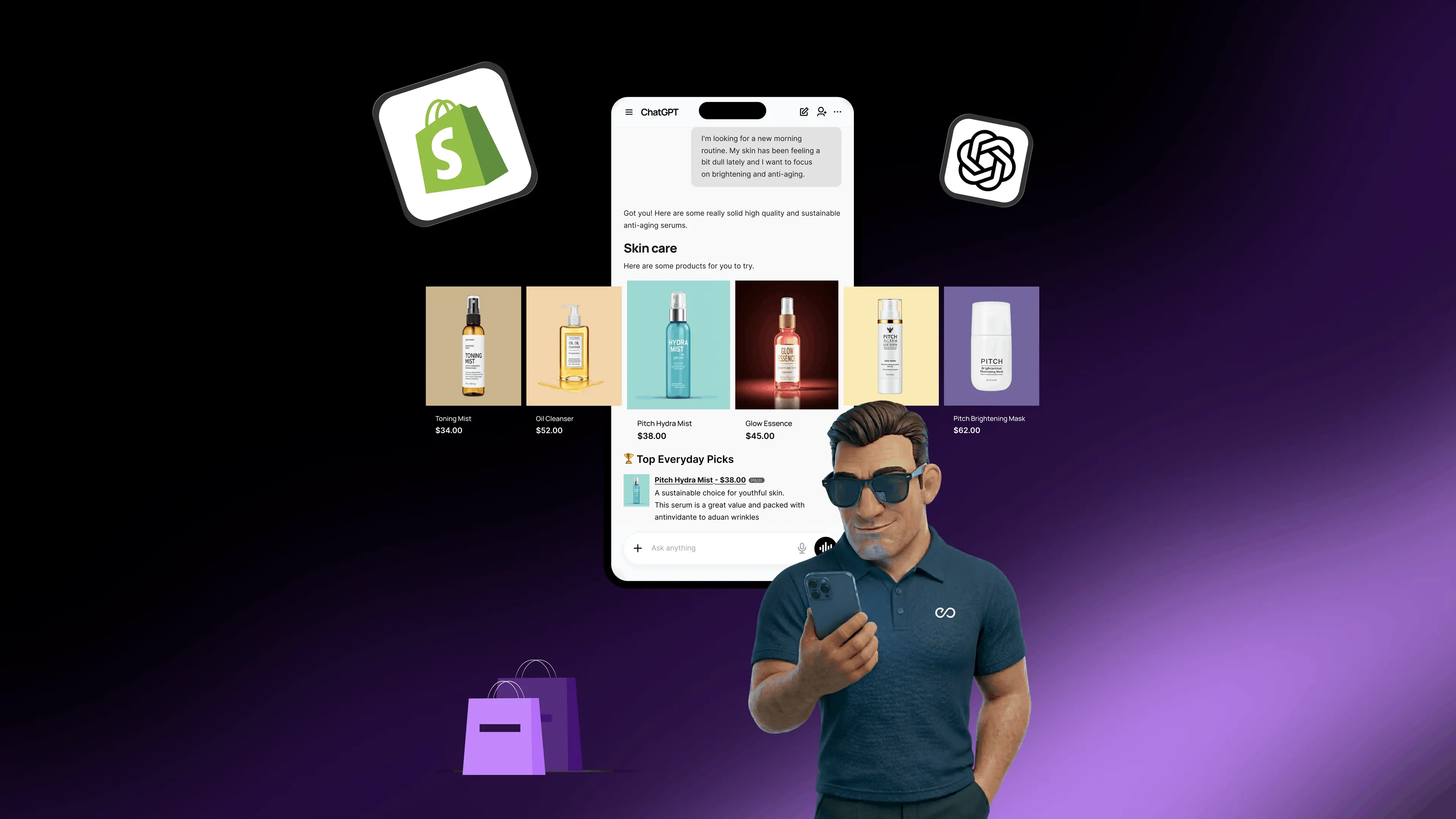
Here's something that would've sounded ridiculous two years ago: your customers are now buying products inside a chatbot.
Not browsing. Not researching. Buying. Discovering a product in a ChatGPT conversation, clicking through, and completing checkout on your Shopify store, without ever opening Google, visiting your homepage, or scrolling through a collection page.
And as of late March 2026, this isn't a beta. It's not a pilot program. Every Shopify store is now discoverable inside ChatGPT by default. Your products are showing up in AI conversations whether you've optimised for it or not.
The numbers back up why this matters:
Shopify has been ahead of every major commerce shift, from web storefronts to social selling to POS. Now they've done it again with AI shopping. And the merchants who move fastest will own this channel, just as early Instagram sellers owned social commerce.
This isn't coming. It's here. Let's break down exactly what happened, why it matters, and what you need to do right now.
In Shopify's Winter '26 Edition, their largest ever, with 150+ updates, they shipped a feature called Agentic Storefronts. It's exactly what it sounds like: your Shopify store becomes an AI-native sales channel.
Here's how it works. When someone asks ChatGPT something like "what's the best organic skincare brand under $50" or "recommend a durable laptop bag for travel," Shopify merchant products now show up directly in the response. The customer sees product details, pricing, images, and everything they need to make a decision. When they're ready to buy, they tap through to your actual Shopify checkout.
On mobile, it opens in an in-app browser inside ChatGPT. On the desktop, it opens a new tab. Either way, the customer completes their purchase on your store, through your checkout, with your branding. You stay the merchant of record. The customer relationship is yours.
And it's not just ChatGPT. Agentic Storefronts connect your products to:
The setup? There basically isn't one. If you're on Shopify, your products are automatically fed into Shopify's Catalogue, a massive product database powered by specialized LLMs that categorise, enrich, and standardise your product data. That Catalogue syndicates your products across every AI platform Shopify partners with. You set up once. Shopify is distributed everywhere.
Every order from an AI channel flows into your Shopify admin like any other sales channel. You get full attribution, tracking, and analytics. No custom integrations. No bespoke API work. It just works.
Here's the backstory most merchants missed. OpenAI originally tried to build its own checkout system called Instant Checkout, allowing people to buy directly in ChatGPT without leaving the conversation. It launched in late 2025 and flopped.
The numbers tell the story. After roughly five months, only about 30 Shopify merchants were available through Instant Checkout. (Team, 2025) Onboarding was painful. The system was limited to single-item purchases from US sellers. And the biggest insight? Users browsed and compared products in ChatGPT but preferred completing purchases on familiar retail sites where they already had accounts and saved payment methods.
OpenAI pulled the plug on Instant Checkout in early March 2026 and pivoted to exactly what Shopify was building: redirect users to the merchant's own storefront for checkout. That's a massive win for Shopify merchants. You keep control of the experience, the data, and the customer.
One fee to be aware of: OpenAI charges merchants a 4% fee on sales through ChatGPT. Google AI Mode, by comparison, charges nothing. (Havervold, 2026)
Here's where things get really interesting. Shopify didn't just build Agentic Storefronts for existing Shopify merchants. They launched a brand new plan, the Agentic plan, that opens AI shopping to any brand, even if they don't use Shopify for their online store.
Think about that for a second. If you're running your store on WooCommerce, BigCommerce, Magento, or even a custom platform, you can now sign up for Shopify's Agentic plan, upload your product data to Shopify Catalogue, and immediately become shoppable across ChatGPT, Google AI Mode, Gemini, Copilot, and the Shop App.
Shopify is positioning itself not just as an e-commerce platform, but as the commerce infrastructure for the AI era. They're saying: "You don't need to migrate your whole store to us. Just plug into our Catalogue and sell wherever AI conversations are happening."
The Catalogue itself is the engine behind all of this. It contains billions of products, and Shopify uses specialised LLMs to:
The Agentic plan is now publicly available globally. Any brand can sign up and start today. And for merchants already on Shopify? You don't need this plan; you're already in.
Also read: Top 30+ Biggest Brands & Names on Shopify
If Agentic Storefronts are the product, the Universal Commerce Protocol is the plumbing that makes it scale.
UCP is an open-source standard co-developed by Shopify and Google, announced at the National Retail Federation conference in January 2026. (Grigorik, 2026) It creates a common language for AI agents to discover, interact with, and transact from any merchant, without requiring custom integrations for each AI platform.
The backing is serious. UCP is endorsed by more than 20 major companies, including:
In March 2026, Google updated UCP with Cart, Catalogue, and Identity Linking capabilities. That means AI agents can now save multiple items to a basket, pull real-time inventory and variant data, and carry a shopper's loyalty benefits across platforms. This is infrastructure being built for the long haul.
For merchants, UCP means you integrate once, and every AI platform that supports the protocol can sell your products. No more building separate feeds for ChatGPT, Google, Copilot, and Perplexity. One protocol, every agent.
The full specification is published at ucp.dev.
Here's the part that should create urgency. AI shopping isn't just a new channel; it's a channel where habits are being formed right now. And in commerce, habits compound.
When someone asks ChatGPT for a product recommendation, and your brand shows up, two things happen. First, they might buy. Second, and this is the bigger play, the AI learns that your brand is relevant to that query. The more your products get surfaced and clicked, the more AI systems associate your brand with those buying signals.
This is fundamentally different from Google, where rankings shift constantly, and a competitor can outbid you tomorrow. In AI shopping, the brands that establish themselves early in conversational recommendations build a compounding advantage that's harder to displace.
The data support this:
The window is right now. Not Q3. Not "when we get around to it." Right now, as recommendations are being established, most of your competitors are still figuring out what agentic commerce even means.
Enough context. Here's what to actually do.
Go to your Shopify Admin → Settings → Sales Channels. Confirm that Agentic Storefronts is enabled. For most stores, it's on by default, but if you've customised your sales channel settings, double-check. This is the switch that makes your products visible to AI platforms.
AI agents don't browse your store the way humans do. They parse data. And the quality of your product data directly determines whether your products get recommended.
Check that the following crawlers are not disallowed:
Customise at Online Store → Themes → Edit Code → robots.txt.liquid.
You can't optimize what you can't measure. Set up tracking for AI-attributed traffic and orders:
AI platforms pull from your entire site when deciding what to recommend. Pages that answer real shopping questions, in natural, conversational language, are gold for AI discovery.
Think about what someone would type into ChatGPT when they're ready to buy. Then make sure your site has content that answers that question better than anyone else.
If you're selling on platforms beyond Shopify, WooCommerce, Amazon, or a custom build, the Agentic plan lets you feed all of those products into the Shopify Catalogue for AI distribution. It's worth evaluating if you want AI channel coverage across your entire catalogue, not just what's on your Shopify store.
If you're an agency or consultant in the Shopify ecosystem, this is the biggest new service opportunity since mobile optimisation.
Merchants know AI shopping exists. Most have no idea how to capitalize on it. That gap is your opportunity.
New service lines to build right now:
The agencies that build expertise in agentic commerce now will own this market for years to come.
Also Read: 20 Best Shopify Apps to Increase Sales in 2026
For years, the playbook for e-commerce was simple: build a great store, drive traffic through Google and social, convert visitors into buyers. That playbook still works. But there's now a parallel channel that's growing faster than anything we've seen since social commerce, and most merchants are ignoring it.
AI shopping is live. Your products are already appearing in ChatGPT conversations; the question is whether they're appearing well. Whether your data is clean enough, your descriptions rich enough, and your structured markup complete enough for AI agents to confidently recommend you over your competitors.
Shopify has built the infrastructure. The Agentic Storefronts are on. The Catalogue is syndicating. UCP is scaling. The only variable left is you.
The merchants who treat this like a real channel, who optimize their data, track their AI traffic, and build content for conversational discovery are going to pull ahead in a way that's hard to catch up to. AI recommendations compound. The brands that are recommended first are recommended more often.
Don't wait for your competitors to figure this out first.
Need help getting your store AI-ready? At Huptech Web, we're helping Shopify merchants optimize for agentic commerce, from product data audits to full GEO implementation. Book a free agentic commerce readiness audit at huptechweb.com/contact, and we'll show you exactly where your store stands and what to fix first.
ChatGPT combines four inputs: structured product data on your pages, AI-readable directives like llms.txt, structured product feeds submitted through partner integrations, and brand authority signals it picks up from third-party sources like press and review sites. Stores that get all four right consistently show up. Stores that nail only one or two usually do not.
Agentic Storefronts is a Shopify feature that makes your products discoverable and purchasable within AI platforms such as ChatGPT, Google AI Mode, Gemini, Microsoft Copilot, and Perplexity. Customers find your products in AI conversations and complete checkout on your actual Shopify store.
For most Shopify stores, Agentic Storefronts is enabled by default. Your products are automatically added to the Shopify Catalogue, which syndicates them across AI platforms. Verify it's active in your Sales Channels settings and optimize your product data for best results.
Open ChatGPT and ask 'what are some good Shopify stores selling [your product category]' and similar variations. If your store appears, good. If not, ask 'what does [your brand name] sell' to see whether ChatGPT knows about you at all. If the second question returns a vague or incorrect answer, your brand authority signals are the gap.
When a customer discovers your product in a ChatGPT conversation, they click through to your Shopify storefront in an in-app browser on mobile or in a new tab on desktop. They complete checkout in your store using your checkout flow and branding. You remain the merchant of record.
A new Shopify plan for brands that don't use Shopify as their primary platform. It lets any brand upload products to the Shopify Catalogue and become shoppable across AI channels, even if their main store runs on WooCommerce, BigCommerce, or a custom build.
Agentic Storefronts are included in your Shopify plan at no extra cost. OpenAI charges a 4% fee on ChatGPT sales. Google AI Mode currently charges no fees.
AI channel orders show up in your Shopify admin with separate attribution labels. Set up GA4 segments for referral traffic from chat.openai.com, copilot.microsoft.com, and perplexity.ai.
The Universal Commerce Protocol is an open-source standard co-developed by Shopify and Google. It creates a common language for AI agents to interact with merchants, backed by 20+ major retailers and payment providers.
No. Agentic Storefronts is an additional sales channel alongside your existing store. Your store remains the checkout destination for AI-referred customers.

Drop your details and we'll email the download link straight to your inbox.