


E-Commerce•24 Min
Top 10 Payment Gateways in the UAE Compared (Telr, Network International, Tabby, Tamara, and More)

Written byRishi Thacker
Posted onJul 15, 2026



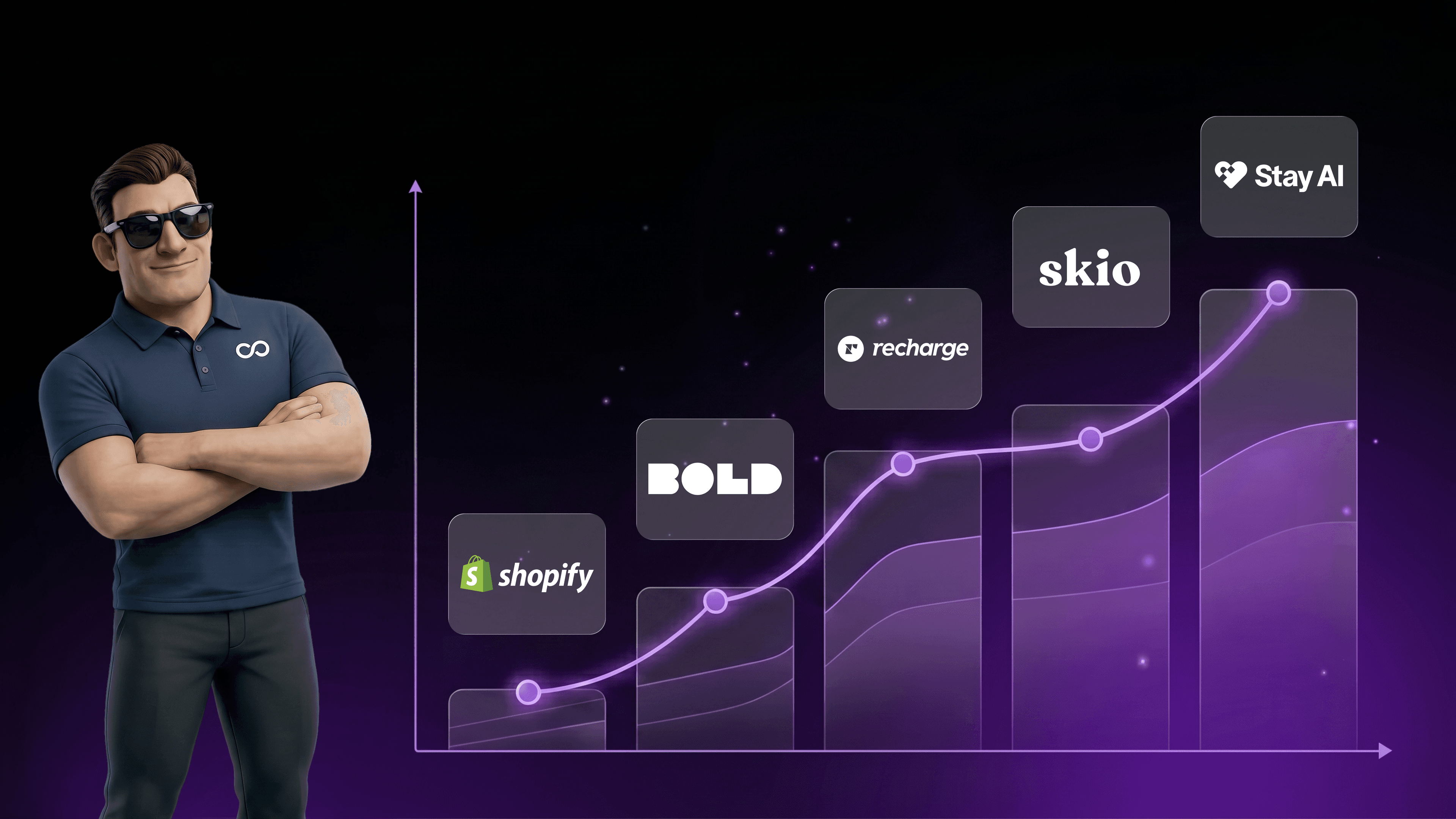
Five real subscription options exist for Shopify in 2026: Shopify Subscriptions (free native app), Recharge, Bold Subscriptions, Skio (acquired by Recharge in April 2026), and Stay AI. Native fits stores under £100K subscription revenue. Bold fits SMB with simple recurring billing. Recharge fits mid-market to enterprise. Stay AI fits brands optimising for retention through A/B testing. Skio still leads on passwordless customer portals. Wrong choice means a painful migration 18 months later.
Subscription tooling on Shopify is unusually crowded for a single category. Most ecommerce app categories have one or two clear winners. Subscriptions has five serious options, each strong in a different scenario, and the recent April 2026 Recharge acquisition of Skio for $105M reshuffled the deck.
Picking wrong is expensive. Migrating subscribers between platforms means re-tokenising payment methods, transitioning billing cycles mid-month, communicating the change to active subscribers, and accepting a measurable churn spike during the move. Most subscription brands we work with at Huptech Web pick once and live with the consequences for two to three years. This is the decision framework we use to make the call.
| App | Best for | Starting price | Transaction fees | 2026 status |
|---|---|---|---|---|
| Shopify Subscriptions (native) | Stores under £100K subscription revenue | Free | Standard Shopify Payments rates | Active, expanding capability |
| Bold Subscriptions | SMB with simple recurring billing | ~$25–40/mo | 1–2% | Independent, Checkout-native |
| Recharge | Mid-market to enterprise DTC | $25 Starter / $99 Standard / $499 Pro | 1–1.25% + $0.19/order | Acquired Skio April 2026 |
| Skio (now under Recharge) | Shopify Plus DTC focused on retention UX | $499 annual / $599 monthly | 1% + $0.20/order | Operating separately, joint roadmap |
| Stay AI | Brands optimising LTV through experimentation | $499/mo | Included | Independent, ML-focused |
All five integrate with Shopify Checkout Extensibility. All five support pause, skip, swap, and cancel flows at varying depths. The differences worth paying for show up in the customer portal experience, the analytics layer, the experimentation tooling, and the cost at scale.
Recharge acquired Skio for $105 million cash on 30 April 2026, the largest private acquisition in Shopify subscription history according to TechCrunch coverage. Skio had reached $32M ARR and processed $4B in subscription payments on only $8M of raised capital, run by solo founder Kennan Frost.
Three practical implications for merchants. First, Skio and Recharge continue to operate as separate products with a joint roadmap. If you're already on Skio you don't need to migrate, and new Skio installs still happen. Second, the combined entity now serves 20,000+ brands processing $20B in GMV, which makes Recharge the clear category incumbent by a wide margin. Third, Skio's passwordless customer portal (4-digit SMS or email code, no passwords) which reportedly cuts subscription support tickets by more than 80%, is now part of the Recharge roadmap rather than a competing product.
For a merchant evaluating today, the decision shrinks from five real options to four: native Shopify, Bold, the Recharge-Skio combined platform, and Stay AI. Skio specifically still makes sense as an install for stores prioritising the passwordless portal experience, but the long-run platform direction now sits inside Recharge.
The native Shopify Subscriptions app handles the simplest recurring-billing job well. Set up a subscription product, customers buy it, Shopify charges them on the cadence you defined, payments process through Shopify Payments (preferred) or supported gateways like Stripe, Authorize.net, PayPal Express, or Adyen. POS-based subscriptions specifically require Shopify Payments.
What it doesn't do: limited customer portal (pause, skip, cancel only, with no mid-cycle SKU swaps or quantity changes through self-service), no cohort LTV analysis, no MRR waterfall reporting, no voluntary-vs-involuntary churn split, no build-a-box or bundle builders, no advanced retention or save flows on cancel. Gift cards apply only to the first payment. The free price is real but the ceiling is low.
Best fit: stores under £100K (~$130K) in annual subscription revenue, with one or two subscribed products and standard monthly or quarterly cadences. Once you're past that scale and need cohort analytics, you'll outgrow it.
Recharge has been the category default since 2014. Largest install base, deepest integration ecosystem (Klaviyo, Postscript, Gorgias, Attentive, Yotpo, LoyaltyLion), broadest theme integration support, and the most mature analytics layer covering cohort LTV, churn breakdown, and revenue forecasting. With Skio inside the combined entity, the roadmap now includes Skio's passwordless portal as well.
Pricing: Starter at $25/month (50 subscribers cap, new merchants only), Standard at $99/month + 1.25% + $0.19/order, Pro at $499/month + 1% + $0.19/order, custom Enterprise above that. 60-day free trial. [VERIFY current pricing on getrecharge.com/pricing]
Best fit: mid-market to enterprise DTC brands, particularly above $500K annual subscription revenue. The transaction fees become meaningful at scale, but the analytics, retention tooling, and ecosystem integration value tend to outweigh them above $1M.
Skio's defining product feature is the passwordless customer portal: subscribers manage their subscription via a 4-digit code sent by SMS or email, with no password to remember or reset. The result is materially fewer "I can't log in" support tickets and a higher rate of self-service portal use. Skio's published numbers claim an 80%+ reduction in subscription support tickets, which directionally lines up with what we've seen on Skio installs.
Skio also pioneered group subscriptions (multiple households on one subscription with shared billing) and ships with experimentation tools, though Stay AI still has the depth advantage on experimentation.
Pricing: $499/month on annual billing or $599/month month-to-month + 1% + $0.20/order. No free trial.
Best fit: Shopify Plus brands where subscription customer-experience friction is the bottleneck on retention, and where the passwordless portal alone would justify the spend. Now that it's inside Recharge, the strategic question of "will this platform still exist in three years" is resolved.
Bold Commerce has been in the subscription space the longest of any vendor here, going back to before Shopify had a native Subscriptions API. Bold Subscriptions for Shopify Checkout was rebuilt for Checkout Extensibility and runs natively in the Shopify checkout flow. The product feels less feature-rich than Recharge or Skio, but the entry pricing is lower and the integration is clean.
Pricing: Around $24.99 to $39.99/month + 1-2% transaction fee depending on plan, with 90 days free for stores under $100/month subscription revenue. Custom volume pricing above $1M ARR. [VERIFY exact tiers]
Best fit: SMB stores with straightforward recurring-billing needs (subscribe-and-save, fixed-cadence replenishment), where you want something more capable than the native app but don't need the full Recharge feature set. Often the right answer for stores running £100K to £500K in annual subscription revenue.
Stay AI's differentiator is ExperienceEngine: a machine-learning-driven A/B testing layer that runs experiments on subscription flows, free-gift offers, cancel flows, and incentive triggers. Predictive churn analytics, dynamic discounting, and retention-optimised messaging are first-class features rather than bolt-ons. If your subscription business is a retention game more than a billing game, Stay AI has tooling none of the others match.
Pricing: $499/month for the Standard plan, unlimited subscriptions, no implementation or migration fees, with Enterprise custom above that.
Best fit: 6-to-8-figure DTC brands where retention and LTV optimisation are the primary growth lever, often skincare, beauty, supplements, pet food, or coffee categories. Brands that already have product-market fit on their subscription offer and now need to squeeze cohort LTV upwards through experimentation.
The five-by-five decision matrix below shows our default recommendation for each combination of subscription complexity and store stage. Treat this as a starting point, not a verdict.
| Scenario | Annual subscription revenue | Best fit |
|---|---|---|
| Single product, monthly cadence, no swap needed | Under £100K | Shopify Subscriptions (native) |
| Multiple products, subscribe-and-save, simple portal needs | £100K–500K | Bold Subscriptions |
| Build-a-box, quantity changes, swap flows, cohort analytics | £500K–2M | Recharge Standard |
| High AOV, complex subscription mechanics, deep integrations | £2M+ | Recharge Pro |
| Passwordless portal critical, support cost reduction priority | £500K+ | Skio |
| Retention optimisation through experimentation, LTV growth | £500K+ | Stay AI |
| Group subscriptions (multi-household billing) | Any tier | Skio |
| B2B subscriptions with Net 30 terms and direct debit | Any tier | Recharge + GoCardless |
Edge cases worth flagging. Stores selling primarily in the UK with significant subscription revenue should pair their chosen app with GoCardless for Bacs Direct Debit, which cuts transaction costs on the recurring charge compared to card-network fees. That stack works under any of the five apps but is most often paired with Recharge or Skio. We covered the broader UK app stack in our 10 best Shopify apps for UK merchants in 2026 post.
Three variables actually drive the decision more reliably than headline pricing.
AOV (average order value). Below $40 AOV, transaction fees of 1-2% sting more than monthly subscription fees, and you want a flat-fee app or the native option. Above $80 AOV, transaction fees become a rounding error and you should optimise for analytics depth and retention tooling instead. The middle band ($40-80) is where the comparison gets genuinely close and you should run the cost math both ways.
Subscription complexity. Three rough tiers. Simple: one product, one cadence, no swaps. Native or Bold both fit. Moderate: multiple products, swap allowed, occasional quantity changes. Bold or Recharge Standard. Complex: build-a-box, dynamic bundles, prepaid plans, gifts, multi-store, custom retention flows. Recharge Pro or Stay AI.
Roadmap horizon. If your subscription business will be a 5+ year asset and you're already past $1M revenue, optimise for the platform you can grow on without migration. That's Recharge or Stay AI today. If you're testing whether subscriptions even work for your category and you'll know inside 12 months, optimise for cheap and easy to migrate later. That's native Shopify Subscriptions.
The cost math at scale. A store doing $2M in annual subscription revenue at $60 AOV is processing about 33,000 subscription transactions per year. At Recharge Standard (1.25% + $0.19/order), that's $25,000 in percentage fees plus $6,270 in per-order fees plus $99/month, roughly $32,500/year. At Recharge Pro (1% + $0.19/order plus $499/month), the same volume costs $20,000 + $6,270 + $5,988, roughly $32,300/year. The Pro tier breaks even at around this scale, then saves money as you grow. Skio at 1% + $0.20/order plus $499/month costs $20,000 + $6,600 + $5,988, roughly $32,600/year. The platforms converge in cost at the scale where the analytics depth starts to matter most.
For broader thinking on how subscription content and SEO connect to revenue, our GEO audit checklist is the companion piece on the discovery layer.
Migration cost is the silent killer of subscription-app decisions. Three buckets to budget for.
Direct migration cost. Most subscription apps offer migration support either free or at modest cost. Stay AI advertises no migration fees on their Standard plan. Recharge migration runs free for most plans with optional concierge support at enterprise tier. Skio's migration team is one of the strongest in the category. Bold migrations are typically self-serve or partner-led. Budget: $0-$10,000 depending on subscriber count and complexity.
Churn during the transition. This is the line item most merchants don't budget for. Re-tokenising payment methods, sending re-authentication emails, dealing with subscribers who lapse during the handover, and the inevitable "I didn't know I was being charged again" support tickets all add up. A clean migration tends to cost 5-10% of active subscribers as transition churn. On a 10,000-subscriber base, that's 500-1,000 lost subscriptions, which at $60 AOV monthly is $30,000-$60,000 in monthly recurring revenue lost.
Internal team time. Migrating subscription platforms typically requires 80-150 hours of internal team time spread across operations, customer service, finance reconciliation, and developer support for theme integration. Cost varies but $10,000-$25,000 in fully-loaded internal cost is typical.
Total realistic switching cost at the mid-market band: $40,000-$85,000 plus 2-3 months of operational distraction. That's why picking the right app first matters more than getting the cheapest monthly fee.
Three patterns repeat across subscription-app decisions, and all three are expensive to fix.
The first is picking by monthly fee rather than total cost. The $25 Starter plan looks cheap until you hit the 50-subscriber cap. The free native app looks cheap until you discover the missing analytics. Total cost of ownership at your projected 18-month subscriber count is the number that matters, not the line item this month.
The second is over-buying capability you won't use for a year. A store at $200K annual subscription revenue does not need Stay AI's ExperienceEngine yet. The retention experimentation flywheel needs a critical mass of subscribers to produce statistically meaningful test results, and 1,500 active subscribers is roughly the floor. Buying enterprise tooling at SMB scale wastes spend without producing the ROI the tooling was built to deliver.
The third is under-buying and migrating in 12 months anyway. The mirror image of the second mistake. Stores that pick the cheapest option to "see if subscriptions work for us," then hit $500K in subscription revenue eight months later and find themselves migrating to Recharge during peak season. The migration math above explains why this hurts.
For Shopify Plus stores planning a subscription launch as part of a broader platform move, our Shopify Plus migration service covers the full scoping process. Subscription-app selection is typically discussed in discovery, not chosen after the migration is complete.
Yes. Recharge acquired Skio on 30 April 2026 for $105 million cash. Skio continues to operate as a separate product with a joint roadmap. Existing Skio merchants do not need to migrate, and new Skio installs are still happening. The strategic question of long-term platform survival is resolved: Skio is now part of the largest subscription platform in the Shopify ecosystem.
For stores under roughly £100K in annual subscription revenue, with one or two subscribed products on simple monthly or quarterly cadences, yes. Above that scale, the lack of cohort analytics, advanced retention tooling, mid-cycle SKU swaps in the customer portal, and revenue forecasting becomes a meaningful constraint. Most stores outgrow it within 18-24 months of meaningful subscription growth.
Not strictly. The native Shopify Subscriptions app works with Shopify Payments, Stripe (for select merchants), Authorize.net, PayPal Express, and Adyen. POS-based subscriptions specifically require Shopify Payments. However, using a third-party gateway means paying that gateway's transaction fees, which usually makes Shopify Payments the most cost-effective option.
Stay AI's ExperienceEngine has more depth for A/B testing subscription flows, free-gift triggers, and cancel-flow experimentation. Recharge's retention tooling is competent but built for billing depth rather than experimentation depth. For brands where retention experimentation is the primary growth lever, Stay AI typically wins. For brands where the subscription is a billing layer on top of a broader product offer, Recharge is usually the better fit.
For a mid-market store, plan on $40,000-$85,000 in total cost: $0-$10,000 in direct migration fees, $30,000-$60,000 in transition churn (typically 5-10% of active subscribers), and $10,000-$25,000 in internal team time. Plus 2-3 months of operational distraction. Picking the right app first is almost always cheaper than switching later.
Technically yes, but it's almost always a bad idea. Customer-portal experience splits across two systems, analytics fragment, and your developer time gets eaten by maintaining two sets of theme integrations. The only common exception is running native Shopify Subscriptions for one specific product line while running Recharge or Skio for the rest. Even then it usually creates more support overhead than it saves.
Recharge has the deepest B2B feature set today, particularly when paired with Shopify B2B catalogues and custom pricing. Pairing it with GoCardless for Bacs Direct Debit on the recurring charge cuts transaction costs significantly compared to card-on-file billing. We covered the broader B2B picture in our Shopify B2B vs Handshake vs Faire breakdown.
The right subscription app is the one that matches your subscription complexity, your AOV, and your three-year roadmap. The wrong subscription app is the one you picked because it was the cheapest this month.
Five real options exist. Native fits under £100K. Bold fits SMB with simple needs. Recharge fits mid-market to enterprise across most categories. Skio fits brands prioritising the customer-portal experience, with the long-run platform direction now sitting inside Recharge. Stay AI fits brands where retention experimentation is the primary growth lever. There is no universally best subscription app on Shopify, and anyone telling you otherwise is selling something.
If you're scoping a subscription launch or evaluating a switch, that's a discovery conversation worth having before you commit to a platform.