



E-Commerce•10 Min
Replatform or Optimize? A Decision Framework for Ageing Ecommerce Stores (2026)

Written byRishi Thacker
Posted onSep 16, 2026



If you run a Shopify store today, you’re probably optimizing for the usual things.
Better rankings. More traffic. Higher conversions.
That has been the playbook for years.
But something fundamental has changed.
Your store is no longer discovered only through search engines. It is now being interpreted, summarized, and recommended by AI tools before users ever reach your site.
Customers are asking ChatGPT what to buy. They are using Perplexity to compare brands. They are relying on AI Overviews and other AI-powered search experiences to filter options before making decisions.
And in that process, one question quietly decides your visibility:
Can AI clearly understand your store?
If the answer is no, you may not just lose traffic. You may be left out of the conversation entirely.
That is where llms.txt enters the picture.
But before we go further, it is important to be clear about what it is and what it is not.
llms.txt was proposed by Jeremy Howard of Answer.AI in September 2024 as a way to provide AI systems with a cleaner, more useful summary of website content. It is currently an unofficial, proposed standard, not an officially adopted one.
That distinction matters.
This is not a proven ranking factor. It is not a guaranteed way to appear in AI answers. And it is not something major AI platforms have officially confirmed as part of their discovery systems.
It is better to think of llms.txt as a promising early-stage tool, one that may become more useful as AI-driven discovery evolves.
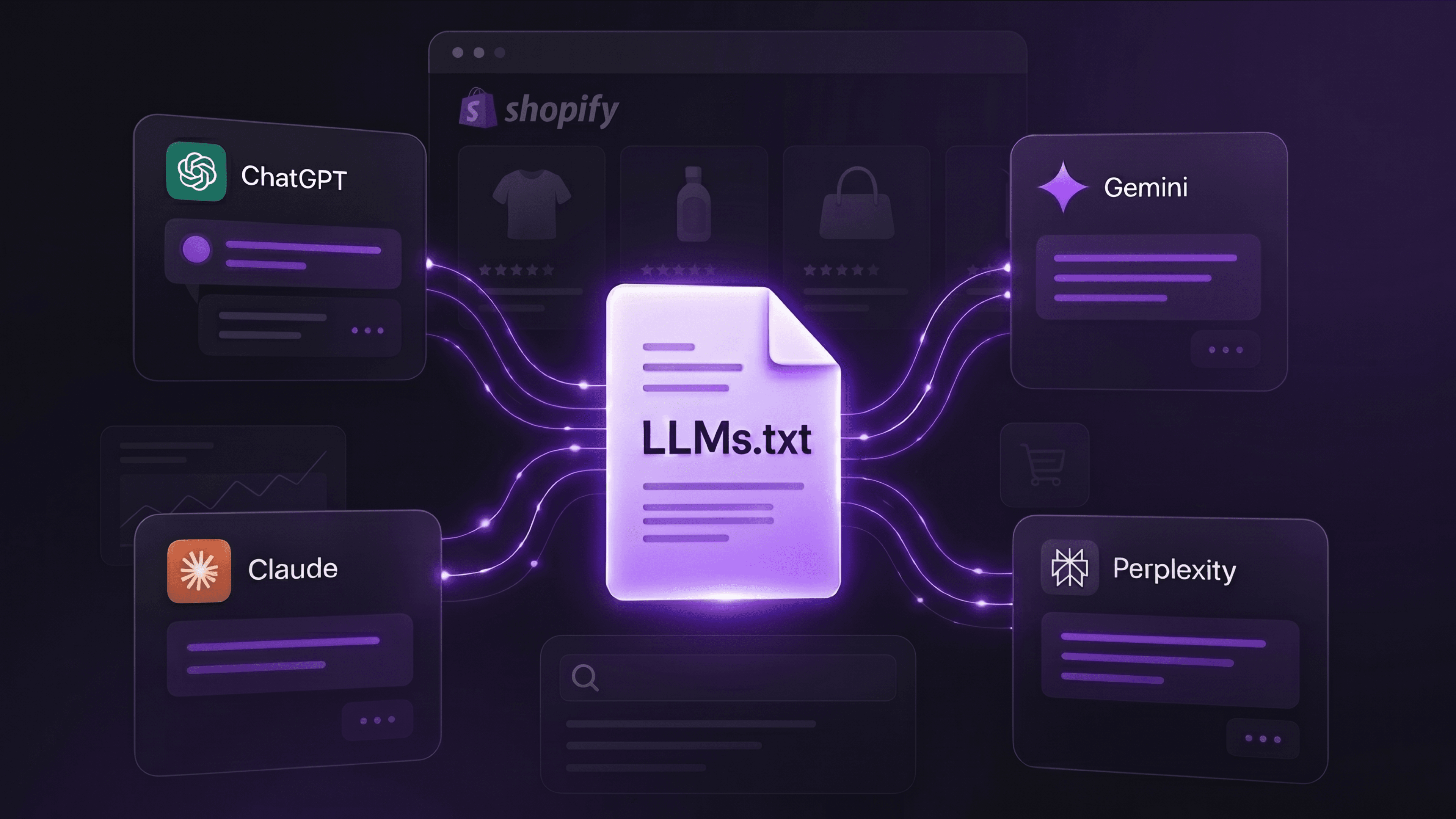
At its core, llms.txt is a simple Markdown file designed to help AI systems understand your website more clearly.
If you are familiar with robots.txt, the idea becomes easier to understand. That file tells search engine crawlers what they can or cannot access. A sitemap helps search engines discover pages.
llms.txt serves a different purpose.
It does not control access. It is designed to provide context.
Instead of saying “do not crawl this,” it is intended to say:
In other words, it is designed to reduce ambiguity.
And in the world of AI interpretation, ambiguity is a problem.
When an AI system scans a website, it has to understand what the brand sells, which pages matter, what content is trustworthy, and how everything connects. If that information is scattered or unclear, the system may not confidently reference the store.
llms.txt attempts to solve that by giving AI tools a cleaner starting point.
Not all websites are equally easy for AI systems to understand.
Shopify stores, in particular, tend to have structural patterns that can make interpretation harder.
Product variants create multiple near-identical pages. Collection filters can generate duplicate or low-value URLs. Product descriptions are often short, repetitive, or copied from suppliers. Content is fragmented across product pages, collection pages, blog posts, and FAQ sections.
For a human user, this may be manageable.
For an AI model trying to summarize your brand in a few lines, it can create confusion.
A Shopify store may have excellent products, but if its content is thin, duplicated, or poorly connected, AI systems may struggle to understand the store’s real positioning.
That is why many Shopify merchants need to think beyond traditional SEO.
It is not only a visibility problem.
It is also an interpretation problem.
To understand why llms.txt matters, you need to understand how AI-powered systems interact with content.
Traditional search engines usually evaluate and rank individual pages. AI systems often try to form a broader understanding of a brand, topic, or product category.
They look for signals such as:
If those signals are weak or scattered, the model may not confidently include your brand in its responses.
This is where llms.txt may become useful.
It acts as a summary layer that is intended to guide AI systems toward the most relevant and useful parts of your website.
But again, this should be framed carefully.
It does not guarantee that AI tools will use the information. It simply gives them a cleaner path if they choose to look for it.
llms.txt does not boost rankings directly. It does not increase traffic overnight. It does not replace SEO, schema, content quality, or brand authority.
What it does is more subtle.
It is designed to help AI systems:
Instead of forcing AI systems to figure everything out from your website structure alone, you provide a curated overview.
That clarity is intended to improve interpretation.
In theory, it may improve your chances over time of being referenced, summarized, or included in AI-generated answers. But current evidence does not prove that adding llms.txt creates measurable visibility gains today.
This is the most important reality check.
As of now, no major AI platform, including OpenAI, Google, or Anthropic, has officially confirmed that it uses llms.txt as a standard signal for discovery, ranking, citation, or recommendation. Google’s John Mueller has also publicly commented that AI crawlers are not widely requesting the file from servers.
There is also research suggesting that llms.txt does not currently produce measurable improvement in AI citations. One analysis of around 300,000 domains found no clear relationship between having llms.txt and being cited more often by AI systems.
So why consider it at all?
Because it is low effort, low risk, and potentially future-friendly.
If implemented honestly and correctly, it does not hurt your store. It may not create an immediate lift, but it can be part of a broader AI visibility strategy. For Shopify merchants who are already investing in SEO, structured data, and content clarity, llms.txt can be treated as an early bet rather than a guaranteed growth lever.
That is the right mindset.
Not hype.
Preparation.
Here’s a hypothetical example of how this could work.
Imagine you run a skincare Shopify store.
Without guidance, AI might see multiple product pages with similar descriptions, a few blog posts with general skincare tips, and scattered mentions of ingredients across different pages.
It may not clearly understand your positioning.
Now imagine adding an llms.txt file that says your store focuses on sensitive skin solutions, highlights your most important product categories, and points to educational guides that explain usage, ingredients, and benefits.
Suddenly, the model has more context.
It may better understand that your brand is not just another skincare store. It is focused on sensitive skin, specific ingredients, and education-led product discovery.
That does not mean the AI system will automatically recommend your store.
But it gives the system a clearer explanation of what your store is about.
It is important to be clear about one thing.
llms.txt is not a replacement for SEO.
It sits on top of your existing efforts.
If your store already has strong technical SEO, well-structured content, clear product positioning, and useful educational pages, llms.txt may enhance how that work is interpreted by AI systems.
If those foundations are missing, llms.txt will not fix the problem.
Think of it as a translator, not a creator.
It can help describe your content more clearly, but it cannot make weak content authoritative. It can point to important pages, but it cannot make those pages valuable. It can support AI readability, but it cannot replace the need for quality, structure, and trust.
The process is simpler than most people expect.
You do not need complex logic or advanced technical knowledge. You need clarity.
Start by identifying your most important pages. These are not all your pages. Only the ones that truly define your business.
For most Shopify stores, this usually includes your best-selling collections, key product pages, high-quality blog guides, FAQ pages, and educational content.
Next, define your core focus.
What do you sell? Who is it for? What problem does it solve? What should AI systems understand about your brand if they only had a few seconds to read your website?
This is where most stores struggle. They try to say too much instead of saying one thing clearly.
The file itself should be written in Markdown format, the same plain-text formatting commonly used in GitHub README files. Markdown is simple, clean, and easy for AI systems to parse and process.
Once created, the file should be placed at the root of your domain:
yourstore.com/llms.txt
There is also an optional companion file called llms-full.txt. While llms.txt is typically used as a concise overview, llms-full.txt can contain more detailed content, documentation, examples, and deeper context for AI tools that need more information.
For a Shopify store, the shorter file can act as the quick map. The fuller version can act as the expanded guide.
You do not need to overbuild it on day one.
Start clean. Keep it focused. Update it as your store evolves.
Because llms.txt is still new, most implementations go wrong in predictable ways.
The first mistake is treating it like robots.txt. Merchants sometimes think the goal is to control AI systems. But llms.txt is not designed as a blocking mechanism. It is designed as a guidance layer.
The second mistake is including too much information. Listing dozens or hundreds of pages can make the file harder to interpret, not easier. The goal is not to recreate your sitemap. The goal is to curate the pages that best explain your store.
The third mistake is ignoring content quality. If your product pages and blogs lack depth, no file can compensate for that. AI systems still need useful, original, well-structured content to work with.
The fourth mistake is forgetting to update it. Your store changes. Products launch. Collections evolve. Blog content grows. Your llms.txt should reflect those changes over time.
A simple file that stays accurate is better than an ambitious file that becomes outdated.
Not directly in the traditional sense.
Search engines do not use llms.txt as a known ranking factor.
However, it belongs to a broader shift toward what is now called Generative Engine Optimization, or GEO.
GEO refers to optimizing your content specifically for AI-powered tools like ChatGPT, Perplexity, Gemini, and Google’s AI Overviews rather than only traditional search engines. Just as SEO helped brands get found on Google, GEO is about making your brand understandable and citable by AI systems. It is an emerging field, and llms.txt is one small piece of that larger strategy.
That means Shopify merchants should not expect llms.txt to replace keyword research, internal linking, schema markup, page speed, or content strategy.
The better view is this:
Read More: GEO: The Foundation of AI Visibility Every Shopify Store Needs
The way users discover products is changing.
Search engines are no longer the only gateway.
AI is becoming a first filter.
Instead of browsing multiple websites, users are increasingly relying on summarized answers. Instead of comparing options manually, they ask AI tools to narrow the list. Instead of clicking ten links, they may trust one recommendation.
In this environment, being ranked is no longer enough.
You need to be understood.
That means your Shopify store needs clearer content, stronger structure, better schema, more useful product education, and consistent brand messaging across pages.
llms.txt can support that direction, but the deeper work happens across your entire website.
No.
llms.txt is a useful starting point, but it works best when your store already has a strong foundation. AI platforms do not rely on a single file to decide which brands to reference. They evaluate the overall quality, structure, and authority of your entire website.
That is why Shopify merchants should treat llms.txt as one supporting signal, not a complete AI visibility strategy.
AI tools prioritize content that clearly answers specific questions. If your product descriptions are generic, duplicated, or copied from suppliers, they are unlikely to create strong brand understanding.
Your product pages should be detailed, unique, and benefit-focused. They should explain what the product does, who it is for, how it is used, and why it matters.
Blog posts and guides also play a major role. Content that demonstrates real expertise is more likely to be understood, summarized, and potentially cited by AI systems. Thin, duplicated, or keyword-stuffed content is usually easier to ignore.
AI crawlers and search crawlers still need access to your content. If tools like GPTBot, ClaudeBot, or PerplexityBot are blocked in your robots.txt, they may not be able to process your pages.
A clean URL structure also matters. Shopify stores can create excessive dynamic URLs through filters, tags, parameters, and variants. These can generate near-duplicate pages that dilute clarity.
Fast-loading, mobile-friendly pages are also easier for crawlers to process efficiently. Technical cleanliness does not guarantee AI visibility, but it removes unnecessary barriers.
Internal linking tells both users and crawlers which pages matter most.
For Shopify stores, this means linking from blog posts to relevant collections and products using descriptive anchor text. A blog about “how to choose running shoes” should naturally link to the running shoe collection and relevant product pages.
Topic clusters are especially useful. A main pillar guide supported by several related articles creates a stronger topical footprint.
Orphan pages, meaning pages with no internal links pointing to them, are easier for crawlers and AI systems to miss.
Schema markup gives explicit meaning to your content.
Product schema can help identify price, availability, product descriptions, and reviews. FAQ schema can make answers easier to extract. Article and HowTo schema can help clarify educational content.
Shopify includes some basic structured data depending on the theme, but it often needs to be extended for stronger coverage.
For AI visibility, schema is not just a technical SEO detail. It is a clarity signal.
AI tools tend to favor brands that are mentioned across authoritative third-party websites.
Press coverage, industry blogs, review platforms, niche directories, interviews, and trusted publications all help build external authority.
Even unlinked brand mentions can matter because AI systems read context and association, not just backlinks. If your brand is consistently mentioned in relevant places, AI systems may have more confidence connecting your store to a specific category or need.
Experience, Expertise, Authority, and Trust matter even more in AI-driven discovery.
Author bios, case studies, certifications, verified reviews, transparent policies, and clear contact information all help reinforce trust.
For Shopify stores, this can also include founder stories, sourcing transparency, ingredient details, manufacturing standards, product testing information, and customer education.
The more trustworthy your brand appears across the site, the easier it becomes for AI systems to understand why your store should be taken seriously.
Technical SEO still matters.
If your sitemap is missing, outdated, or incomplete, crawlers may miss important pages. Canonical tags help prevent duplicate product variants or filtered pages from competing with each other. Hreflang tags matter for international Shopify stores because AI systems need to know which language or regional version to reference.
Core Web Vitals and page speed also remain important parts of the overall experience. They may not be direct AI citation factors, but they influence crawl efficiency, usability, and search performance.
AI builds an understanding of your brand by reading multiple pages.
If your homepage says one thing, your collection pages say another, and your blog content has a completely different tone, that inconsistency creates confusion.
Your homepage, About page, product pages, collection pages, and blog should all reinforce the same core positioning.
Avoid contradictory claims. Do not call yourself premium on one page and budget-focused on another unless that distinction is clearly explained.
A consistent brand voice helps AI systems more confidently associate your store with a specific audience, product category, or need.
llms.txt is a valuable addition to your AI visibility strategy, but it performs best when these foundations are already in place. Think of it as a finishing layer, not the first step.
The Shopify stores that will win in AI-driven discovery are the ones investing in content depth, technical health, and brand authority first. llms.txt can then help AI tools find and interpret that work more efficiently if they choose to use it.
llms.txt is not a magic tool.
It will not transform your store overnight. It will not replace SEO. It will not generate traffic on its own.
But it represents something important.
A shift in how visibility works.
For years, ecommerce growth has been about being found.
Now, it is also about being interpreted.
That is why Shopify merchants should treat llms.txt as an early-stage layer in a broader AI visibility strategy.
Not because it is proven to deliver results today.
But because it encourages the right behavior: clearer content, better structure, stronger hierarchy, and a more intentional explanation of what your store actually offers.
The brands that adapt early will not be the ones chasing every new AI tactic.
They will be the ones building websites that are easier to understand, easier to trust, and easier to recommend.
Also Read: Your Shopify Store Is Now Shoppable Inside ChatGPT
At Huptech Web, we focus on more than just rankings.
We help Shopify brands build:
If you want your store to perform not just in search engines, but also in AI-driven platforms, the foundation needs to be built correctly.
And that’s where we can help.

Drop your details and we'll email the download link straight to your inbox.