




E-Commerce•10 Min
Replatform or Optimize? A Decision Framework for Ageing Ecommerce Stores (2026)

Written byRishi Thacker
Posted onSep 16, 2026
We’re exhibiting at Seamless Middle East 2026



As of September 1, 2026, three Shopify changes need merchant attention: script tags now have a final shutdown date of March 1, 2027, the August 26 checkout deadline for non-Plus stores has passed, and inventory reports switched to on-hand quantity on September 1.
Everything below is ranked by what it costs you to ignore. Last verified against the official Shopify changelog: September 1, 2026.
The world of eCommerce moves fast. Shopify is moving faster. Between the Summer '25 "Horizons" Edition, the Winter '26 "RenAIssance" Edition, and the wave of API deprecations rolling through April, May, and June 2026, Shopify has shipped more breaking changes and platform-defining features in the last twelve months than in the three years before it. New AI tools, new theme foundations, new sales channels, and several hard deadlines that can quietly cost you revenue if you miss them are all live right now. For Shopify store owners, developers, and agencies, staying current on these updates is more than just a smart move. It is essential for your success. In this guide, you will discover why Shopify's changelog matters in 2026 and learn how to use the latest releases to keep your store running at its very best.
As a certified Shopify Plus Partner, Huptech Web specializes in helping businesses navigate the complexities of the Shopify ecosystem. We provide expert solutions to optimize stores, ensuring our clients are always leveraging the latest features for maximum growth and efficiency. Understanding these updates is the first step toward building a more powerful and profitable online store.
August 2026 was a deadline month: Shopify gave script tags a final shutdown date of March 1, 2027, ended Delivered Duty Unpaid on Managed Markets, and closed two checkout migration windows, while shipping quieter wins in payments reporting, shipping, and marketing.
At-a-glance table:
| Date | Update | Who should care |
|---|---|---|
| Aug 4 | Microsoft Advertising joins Campaign Autopilot (runs Performance Max campaigns; Autopilot is in early access) | Merchants on Campaign Autopilot |
| Aug 6 | Collect WhatsApp marketing consent on Shopify Forms | Stores building WhatsApp lists |
| Aug 10 | Shop Campaigns performance data (spend, sales, ROAS, CAC) now available through ShopifyQL | Data and marketing teams |
| Aug 11 | Upgraded printed receipt editor covering every receipt type, no Liquid needed | Retail stores on POS |
| Aug 11 | Managed Markets announced the end of DDU support, effective August 24 | Cross-border sellers on Managed Markets |
| Aug 13 | DHL Express labels available in admin for UK, Germany, France, Italy, and Spain | Merchants in those five countries |
| Aug 13 | Taxes now recalculate automatically when you change an order's shipping address | Ops teams that edit orders |
| Aug 13 | Recommended checkout field settings surfaced for eligible stores | Everyone |
| Aug 14 | Inventory reports switch to on-hand quantity, effective September 1 (announced) | Ops teams and anyone reading inventory reports |
| Aug 17 | Redesigned POS channel page with a visual entry point to the POS editor | Retail |
| Aug 21 | Checkout pre-selects the last used payment method for signed-in customers | Stores with saved payment methods enabled (D2C and B2B) |
| Aug 21 | Bulk staff setup, suspension, and reactivation via CSV import | Larger teams |
| Aug 22 | New Shopify Payments activity report: balances, gross activity, fees, payouts, PDF export | Finance teams |
| Aug 24 | Script tags deprecated: creation blocked October 1, 2026, execution stops March 1, 2027 | Any store with apps that inject storefront scripts |
| Aug 24 | US tax now calculated from the fulfillment location your order routing settings assign to each order | US multi-location sellers |
Announced August 24 on the developer changelog: script tags, the mechanism many apps use to load JavaScript onto storefronts without touching theme code, are being retired in two steps. From October 1, 2026, the scriptTagCreate and scriptTagUpdate mutations return errors on every API version (the legacy REST ScriptTag resource also rejects POST and PUT), so version pinning will not defer it. On March 1, 2027, Shopify stops injecting script tags into storefronts entirely. The replacement is app embed blocks shipped in theme app extensions, or web pixels for scripts that only collect analytics.
What to do now: ask every app vendor whose app touches your storefront (reviews widgets, chat, popups, tracking, personalization) whether they load via script tags and what their migration plan is. The biggest risk is older or abandoned apps that quietly stop working in March with no vendor left to fix them. Your developer can audit existing script tags today, since the scriptTags query keeps working for cleanup.
Shopify Managed Markets stopped supporting Delivered Duty Unpaid in every country where it supports Delivered Duty Paid. Markets that used or inherited DDU moved to DDP automatically, which means customers in those markets now pay duties and taxes at checkout instead of to the carrier or customs on delivery. For most stores this is an upgrade: fewer surprise charges, fewer refused deliveries. But your international customers will see higher checkout totals than before, so review your shipping and duties messaging on product and checkout pages this week. If pay-on-delivery was essential to your model, the only route Shopify offered was turning off Managed Markets before August 24.
From September 1, inventory analytics models measure stock by on-hand quantity (every unit physically at a location, including units committed to open orders and unavailable units) instead of available quantity (only sellable units). Data before September 1 is unchanged, so every affected report has a visible step change from September 1. Affected reports include products by sell-through rate, days of inventory remaining, inventory adjustment changes, and ABC product analysis, plus any ShopifyQL query that reads FROM inventory or FROM inventory_by_location.
What to do now: annotate September 1, 2026 in any BI dashboard or spreadsheet that trends these reports, re-baseline sell-through and days-remaining targets, and warn anyone reconciling Shopify reports against an ERP that the definitions no longer match the old exports.
July is young, but two changes are already live and one piece of June fallout is hitting stores this week.
July 1: The EU’s €3 customs duty is now in effect. Announced on the changelog June 26, live July 1: qualifying low-value imports into the EU (orders up to €150) now attract a €3 duty per tariff line, a cart with apparel, cosmetics, and shoes pays it three times, not once. Shopify gives you two ways to account for it at checkout. Full breakdown in the June section below.
July 1: Brazil CNPJ validation now supports alphanumeric identifiers. Only matters if you sell into Brazil. Checkout now accepts Receita Federal’s new alphanumeric CNPJ format automatically, no action needed. One exception: if a custom app of yours validates CNPJs, it must stop assuming numeric-only.
The real July story is Scripts fallout. Shopify Scripts stopped executing entirely on June 30. The common mistake we see: merchants who migrated their discount Scripts but forgot the payment-method gating and shipping-rule Scripts. Run this 10-minute audit today:
If anything broke, the fix is a Shopify Functions migration, our step-by-step guide: Migrate Shopify Scripts to Functions .
Later in July, Shopify also began identity verification for Shopify Partners (July 9) and announced the 2026-10 API changes; one of those, automatic tax recalculation when an order's shipping address changes, reached the admin in August.
June 2026 was the heaviest changelog month of the year so far: the Spring '26 Edition landed on June 17 with 150+ updates, Shopify Scripts executed for the last time on June 30, and Shopify shipped checkout support for the EU’s €3 low-value import duty ahead of its July 1 start date. Here is everything that shipped, ranked by who needs to act.
| Date | Update | Who should care |
|---|---|---|
| Jun 5 | Schedule, publish, and A/B test themes, checkout and customer account configurations | Every merchant running CRO |
| Jun 8 | Multi-location pickup in POS | Retail / omnichannel |
| Jun 13 | Expanded multi-currency payout support (US, HK, SG) | Cross-border sellers |
| Jun 17 | Spring '26 Edition: 150+ updates | Everyone |
| Jun 17 | Channel Markets: channel-specific prices, availability and currency | Multi-channel sellers |
| Jun 17 | Ship and pickup in one order (Plus and Enterprise) | Plus merchants |
| Jun 17 | Address format validation in Checkout Blocks, now for all merchants | Everyone shipping internationally |
| Jun 17 | Customer accounts design uplift (mobile-first) | Everyone |
| Jun 17 | Marketing tab renamed to Growth tab | Everyone |
| Jun 17 | Online Store Editor with Sidekick on mobile | Everyone |
| Jun 18 | Self-serve returns now support cancellations, configurable per market | EU sellers |
| Jun 23 | B2B discounts enabled by default | B2B stores |
| Jun 26 | €3 EU import customs duty: checkout collection support (duty effective July 1) | Anyone shipping into the EU |
| Jun 29 | POS activity log; app pixel activity log | Retail + ops teams |
| Jun 30 | Metafields on inventory transfers; location metafields in Analytics | Ops teams / ERP users |
| Jun 30 | Shopify Scripts stop executing (permanent) | All Plus merchants on Scripts |
Merchants have paid monthly app fees for years to do what Shopify now does natively: schedule, publish, and A/B test themes, checkout configurations, and customer account configurations. This shipped on June 5 and was folded into the Spring '26 Edition announcement two weeks later, so most merchants missed it. What we recommend testing first: your BFCM theme variant, start now, in July, while traffic is calm enough to get clean results. Our BFCM 2026 90-day readiness checklist covers where theme testing fits in the timeline.
From July 1, the EU applies a €3 customs duty to qualifying low-value imports (orders up to €150), and it is charged per tariff line, not per order. A cart with apparel, cosmetics, shoes, and jewellery pays €12, not €3. Shopify shipped two ways to account for the duty at checkout on June 26. What it does not do: file the customs declaration. Collecting the duty at checkout and getting the duty data onto the shipment via your carrier setup are two separate jobs, the second one is still yours, unless you sell through Managed Markets, where Global-e acts as merchant of record and remits duties for you. If you sell from the UK or US into the EU, review your carrier integration this week rather than assuming you’re covered.
Scripts stopped executing on June 30, not deprecated, stopped. If you missed the migration window, work through this in order:

Ignoring Shopify's updates is like driving a car without ever taking it in for a tune-up. Your store might run for a while, but eventually, you'll fall behind on performance, security, and user experience. Paying attention to the Shopify changelog helps you stay competitive and offers significant advantages, especially now that Shopify is becoming an AI-native platform with agentic storefronts that surface your products inside ChatGPT, Perplexity, and Microsoft Copilot.
The risk of falling behind has changed shape in 2026. It is no longer just "your store is slower than it could be." It is "your competitor's products show up in an AI chat answer and yours do not," or "your Shopify Script silently stopped firing on June 30 and your discount stack is broken." The merchants who treat the changelog as a living roadmap are the ones who quietly compound their lead.
Read More: How to Simplify Navigation for a Seamless eCommerce User Journey?
Each Shopify update is designed to make the platform better. These can include bug fixes that resolve frustrating glitches, code optimizations that speed up your site, or new features that streamline the customer journey. For example, in April 2026 Shopify rolled out per-page CSS scoping so that themes only deliver the CSS for sections actually rendered on each page, instead of serving every stylesheet on every page load. While that sounds like a developer detail, those tiny improvements stack up to noticeably faster pages and a measurable lift in conversion rates.
Other recent updates with direct revenue impact include the new Horizon theme foundation (drag-and-drop Theme Blocks with no code required), a product variant ceiling that jumped from 100 to 2,048 variants per product, and Shop Pay and Apple Pay wallet buttons that now live on PDP and Cart pages in mobile apps via the Checkout Kit. Each of these is a small lever that, applied properly, lifts conversion or expands what you can sell. By implementing these changes, you ensure your store is always running as efficiently as possible, which directly impacts user experience and sales.
Read More: How Does Website Navigation Affect Conversion Rates in E-Commerce?
The eCommerce landscape is more competitive than ever, with new trends and customer expectations emerging all the time. Shopify's updates often reflect these shifts, giving you the tools to stay relevant and deliver what your customers expect. Adopting new features quickly puts you ahead of competitors who are slow to adapt. Whether it's introducing a new payment option, improving product filters, configuring your Agentic Storefront presence so your brand appears the way you want inside ChatGPT and Perplexity, or rolling out better marketing tools, being an early adopter signals to your audience that your brand is forward-thinking and responsive.
Huptech Web works closely with clients to help them navigate these changes seamlessly. We analyze each update, highlight valuable opportunities, and manage the integration process to minimize disruption. It allows you to focus on running your business and maximizing the benefits of every update.
To make the most of the shopify changelog, you need to know how to read them. Shopify structures its updates to be as clear as possible, typically including the date, type of change, and a brief description.
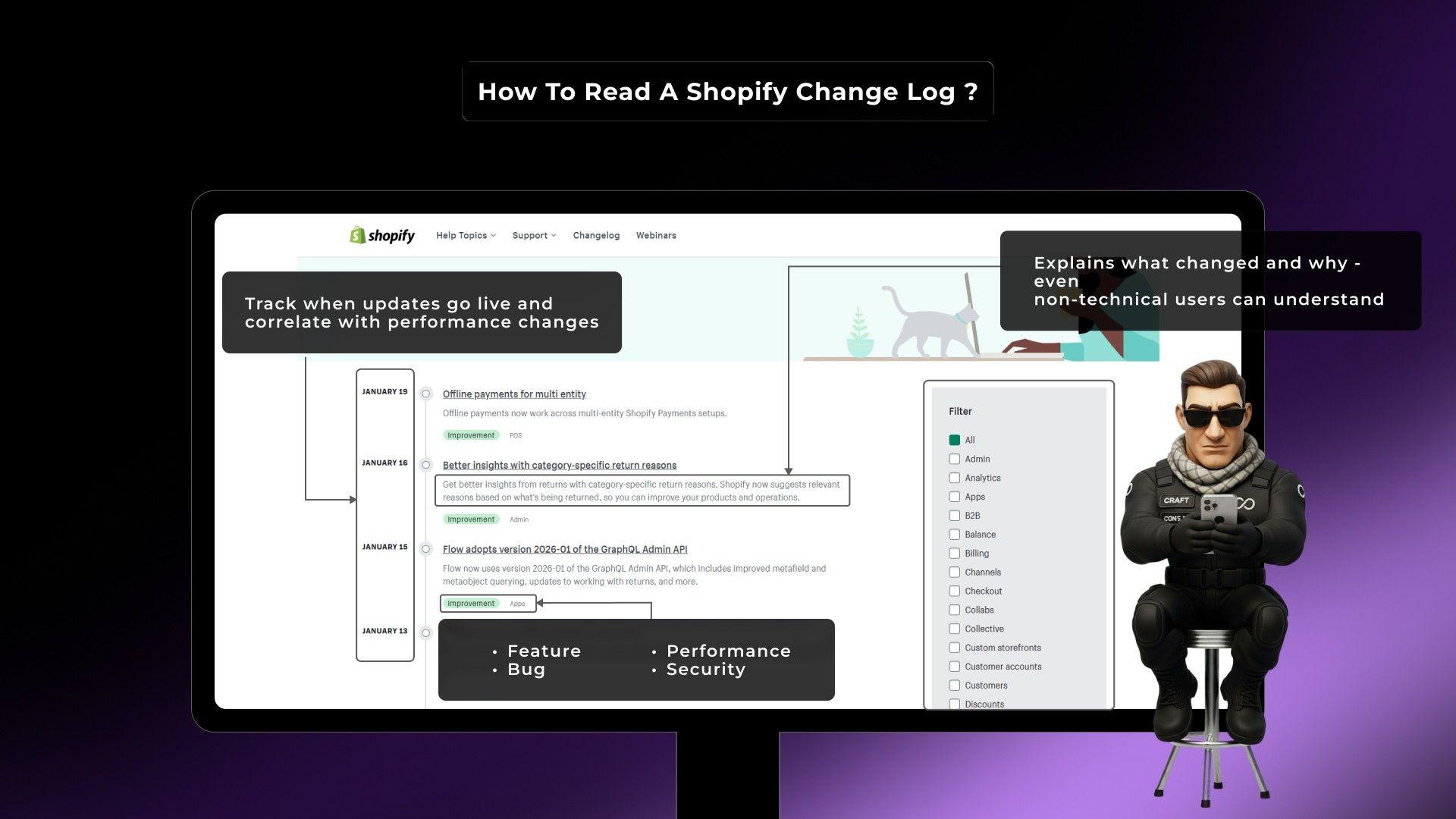
A simple test we use with clients: read the first paragraph, then ask, "Does this change something my customers will notice, something my staff will touch, or something my apps depend on?" If yes, action it. If no, archive it.
While Shopify releases updates constantly, some have a more significant impact than others. The two big launches that have reshaped the platform in the last twelve months are the Summer '25 "Horizons" Edition (released May 21, 2025) and the Winter '26 "RenAIssance" Edition (released late 2025 / early 2026). Together they shipped over 300 updates. Here are the changes that have been particularly important for merchants and developers.
Shopify has completed its multi-year shift away from checkout.liquid toward Checkout Extensibility. This allows for the integration of custom apps and UI extensions directly into the checkout process without editing the checkout.liquid file. It's a game-changer for creating unique, branded checkout experiences that can boost conversions, and it is no longer optional. The deadline for Shopify Plus Thank You and Order Status pages was August 28, 2025, and that has already passed. Non-Plus stores have until August 26, 2026 to migrate. The main checkout pages (Information, Shipping, Payment) moved off checkout.liquid back in August 2024.
Our Recommendation: We advise our Shopify Plus clients to verify that every analytics pixel, upsell app, and post-purchase tool that previously lived on a Liquid Thank You page has been re-implemented as a checkout UI extension or Web Pixel. This future-proofs your store and opens up new opportunities for upselling, custom field collection, and loyalty program integration right at the point of sale. For non-Plus merchants who missed the August 26 date, treat the fix as urgent: anything that lived on your legacy Thank You or Order Status pages is not firing.
Shopify regularly releases new API versions that offer more powerful and efficient ways for apps and custom integrations to interact with the platform. With each new release, older versions are eventually phased out. The current stable version is 2026-07 (released July 1, 2026, adding draft-order deposits for Plus, channel markets, and order attribution definitions, 2026-10 arrives October 1, 2026, and API version 2025-10 is retired on October 16, 2026.). The previous release, 2026-04, shipped several changes that affect live stores: barcode support on inventory shipments, tags for discounts, support for multiple product discounts per cart line (helpful for merchants migrating off Scripts), and the removal of checkout metafields in checkout and customer account UI extensions (replaced by cart metafields and order metafields respectively).
The other major deprecation merchants must plan for is Shopify Scripts. Scripts can no longer be edited or published after April 15, 2026, and they stop executing entirely on June 30, 2026. All Scripts must be migrated to Shopify Functions before that date. If your store uses Scripts for tiered discounts, shipping rules, or payment-method gating, this is the single most common revenue-leak risk we see in audits right now. Two more dates worth pinning: starting April 1, 2026, every new public app submitted to the Shopify App Store must use expiring offline access tokens, and in May 2026 the Shopify CLI removes the --force flag (CI/CD pipelines should switch to --allow-updates).
Our Recommendation: It's crucial for developers and merchants using custom apps to stay updated on the API release cycle. We conduct regular audits for our clients to ensure their apps use supported API versions, which prevents any breakage or loss of functionality. For Plus merchants, we treat the April to June 2026 window as a regulatory deadline and budget the Scripts to Functions migration ahead of it.
Shopify's investment in headless commerce continues with updates to Hydrogen (a React-based framework) and Oxygen (its deployment platform). These tools enable the creation of incredibly fast, dynamic storefronts that can deliver an app-like user experience on the web. The most consequential 2026 update is that headless storefronts built on Hydrogen are now first-class agentic citizens through Storefront MCP, meaning they can be discovered and transacted against by AI agents (ChatGPT, Perplexity, Microsoft Copilot) the same way native Shopify storefronts can, with no special integration required.
Our Recommendation: For brands looking to create a truly unique and high-performance shopping experience, exploring a headless build with Hydrogen is a powerful option, and the agentic commerce tooling has tipped the value calculation even further in its favor. Our Shopify development experts can help you determine if a headless architecture is the right fit for your business goals.
Added in the Winter '26 RenAIssance Edition, Shopify Agentic Storefronts is the most important new feature for merchants in years. It pushes your products into AI conversations on platforms like ChatGPT, Perplexity, and Microsoft Copilot through the Shopify Catalog with one configuration in your admin. By late March 2026, every Shopify store appears inside ChatGPT by default. The only question is whether you have actively shaped how your brand is described or left it to the platform default.
Our Recommendation: Treat agentic commerce as a real channel, not a future curiosity. The same care you put into Google SEO needs to extend to how AI agents parse your product titles, descriptions, images, and structured data. We help clients configure their Agentic Storefront presence and optimize their catalog for AI surfaces alongside their traditional SEO program.
The Summer '25 Edition turned Sidekick from a chat-style helper into a real assistant: multi-step reasoning, visual generation from prompts, mobile support, voice and screen-share, and 20 languages. The Winter '26 Edition went further, letting you click any element in the theme editor and tell Sidekick "make this button rounded," and letting you describe automations to Flow in plain English ("tag any customer who places an order over $200"). Sidekick Skills lets you save and share your best prompts across your team. A new tool called SimGym, trained on billions of customer-behavior data points, simulates how real users will interact with your store before you push changes live, which is invaluable for catching friction in PDP redesigns and checkout extensions.
Our Recommendation: Schedule Sidekick into your weekly admin time. Most merchants still use it as a chatbot. The merchants getting the most value from it are using it as an editor and operator: bulk product cleanup, automated tagging via Flow, theme micro-edits via natural language, and prompt libraries via Sidekick Skills.
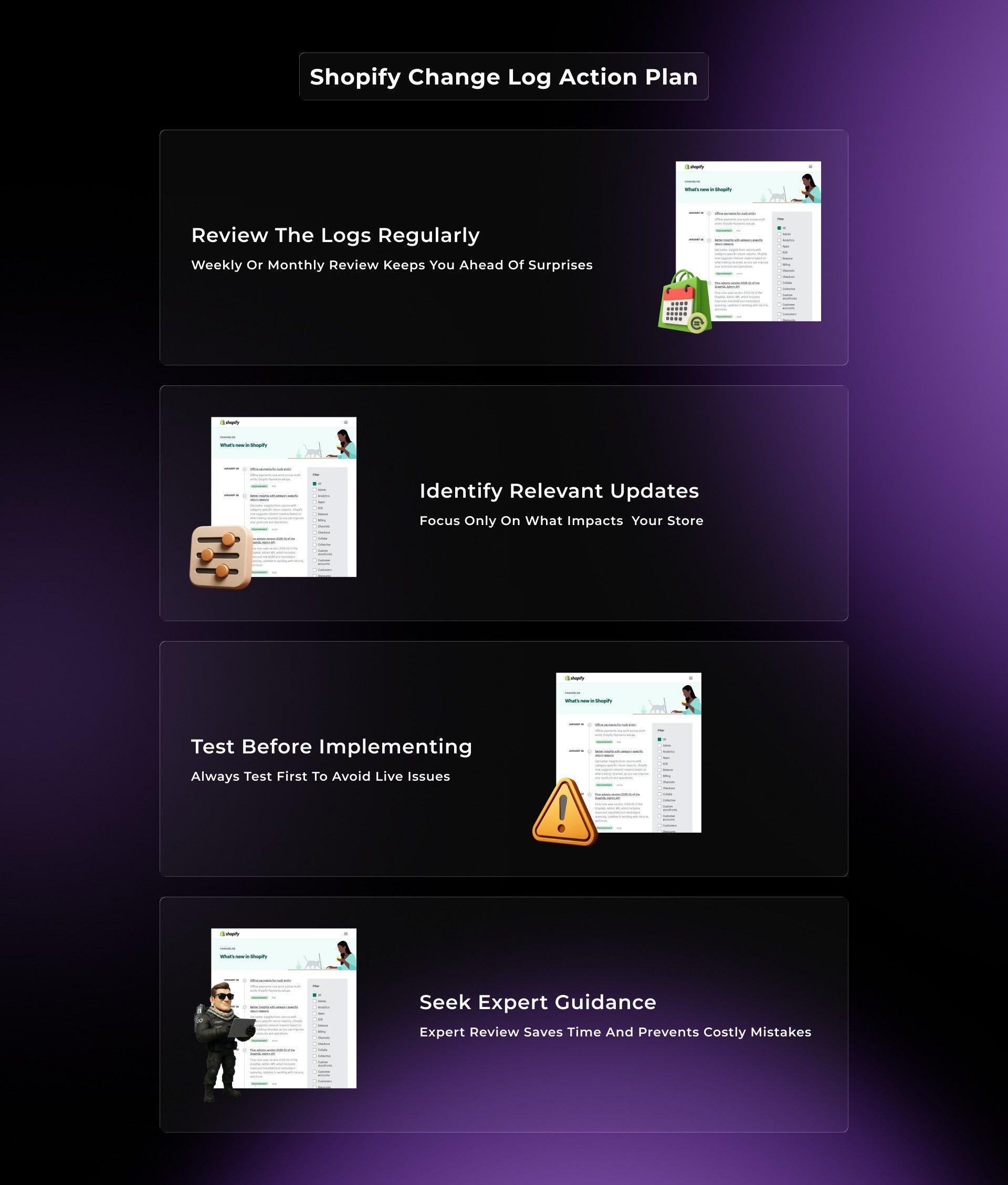
Knowing about the updates is one thing; implementing them is another. Here’s a simple plan for leveraging Shopify's changelog.
This is the section to print, post on the wall, and hand to your developer or agency. Missing any of these will cost you money or break your store.
| Deadline | What's happening | Who it affects |
|---|---|---|
| Oct 1, 2026 | scriptTagCreate and scriptTagUpdate start returning errors on all API versions; the REST ScriptTag resource rejects POST and PUT. Existing script tags keep running. | App developers |
| Oct 1, 2026 | API version 2026-10 becomes stable; version 2025-10 is retired on October 16, 2026. | Custom apps and integrations |
| Dec 1, 2026 | New Built for Shopify requirements take effect for Returns and exchanges apps and Subscription apps. | App developers in those categories |
| Jan 1, 2027 | Customized Liquid receipt templates must move to the 2027 printed receipt editor (auto-migrated after; the switch is irreversible). | Retail stores with custom printed receipts |
| Jan 1, 2027 | Expiring offline access tokens become required for ALL public apps (not just new ones). | App developers; merchants on custom integrations |
| Mar 1, 2027 | Shopify stops injecting script tags into storefronts entirely. | Any store using apps that load JavaScript via script tags |
| Deadline | What happened | If you missed it |
|---|---|---|
|
Aug 28, 2025 |
Plus Thank You / Order Status pages moved to Checkout Extensibility. | Pixels and upsells on old pages stopped firing. Re-implement as UI extensions. |
|
Apr 1, 2026 |
New public apps require expiring offline access tokens. | App developers: resubmit with token rotation. |
|
Apr 15, 2026 |
Scripts locked (no edit / publish). | None. |
|
Apr 20, 2026 |
Automatic CSS subsetting for stylesheet tags went live. | Self-contained CSS needs nothing; if a stylesheet styles elements defined in other files, fix that pattern. |
| May 2026 | Shopify CLI removed the --force flag. | Switch CI/CD pipelines to --allow-updates / --allow-deletes. Format flags as code in the CMS so double hyphens are not auto-converted. |
|
Jun 30, 2026 |
Shopify Scripts stopped executing. | Run the triage in the June section, then migrate to Functions (link the migration guide). |
|
Aug 24, 2026 |
Managed Markets stopped supporting DDU; affected markets moved to DDP. | Duties are now collected at checkout. If customers must pay on delivery, turn off Managed Markets for those markets. |
|
Aug 26, 2026 |
Non-Plus Thank You / Order Status pages: script tags and legacy customizations ended. | Legacy pixels and upsell apps stopped firing. Rebuild them as checkout UI extensions and web pixels now. |
|
Aug 31, 2026 |
Checkout Blocks "Address Blocker" sunset. | Compatible settings were auto-migrated to the native Address format validation rule (Settings, then Checkout, then Checkout rules). Verify the migration and recreate only rules that did not carry over. |
Staying up to date with every Shopify update can feel overwhelming. That's where Huptech Web steps in. As a certified Shopify Plus Partner, we know Shopify inside and out. Our dedicated team helps you make the most of every change, so your store is always at its best.
Shopify's changelog is more than just a technical list of updates; they are a roadmap for keeping your eCommerce business competitive and successful. By paying attention to these changes and understanding their implications, especially the agentic commerce shift, the Scripts to Functions sunset, and the checkout extensibility deadlines, you can enhance your store's performance, improve the customer experience, and ultimately drive more sales.
Ready to make sure your Shopify store is always optimized for success? Contact us today!
The Shopify changelog is Shopify's official, near-daily log of every meaningful change to the platform, including new features, API releases, deprecations, fixes, and behavior changes. It lives at shopify.dev/changelog, with a merchant-facing summary at changelog.shopify.com.
The Spring '26 Edition went live on June 17, 2026 with more than 150 updates. The highlights for merchants: native theme and checkout A/B testing, Channel Markets (channel-specific pricing, availability, and currency), ship-and-pickup in a single order for Plus and Enterprise, a mobile-first customer accounts redesign, and address format validation in Checkout Blocks for all merchants.
They stopped executing permanently. Discounts, shipping rules, and payment-method gating built on Scripts no longer run. Migrate to Shopify Functions; until you do, your store is silently missing whatever behavior those Scripts controlled.
From July 1, 2026, the EU applies a €3 customs duty to qualifying low-value imports (orders up to €150), charged per tariff line, a multi-category cart pays it several times. Shopify supports two ways to account for the duty at checkout (announced June 26). Merchants remain responsible for the customs declaration itself unless they use Managed Markets, where Global-e remits duties as merchant of record.
2026-07, released July 1, 2026. It adds draft-order deposits (Plus), channel markets, order attribution definitions for sales channel apps, and market-driven shipping configuration. If you run custom apps or integrations, check them against it. The next stable version, 2026-10, releases on October 1, 2026.
Shopify ships changelog entries on a near-daily basis. Twice a year, typically in summer and winter, those updates are bundled into a curated Shopify Editions launch with 100 to 150+ highlighted features. The most recent are Summer '25 (Horizons), Winter '26 (The RenAIssance), and Spring '26 (live June 17, 2026, with 150+ updates).
Shopify Scripts stopped executing on June 30, 2026. Editing and publishing was already disabled on April 15, 2026. Any store still relying on Scripts has non-functioning discount, shipping, or payment logic right now and needs to migrate to Shopify Functions.
Note: Shopify Scripts are separate from script tags, the app-injected storefront JavaScript mechanism, which keeps running until March 1, 2027.
That deadline has passed. checkout.liquid itself was Plus-only; for non-Plus stores, what ended on August 26, 2026 was support for script tags and legacy customizations on the Thank You and Order Status pages. Plus merchants' equivalent deadline was August 28, 2025, and the Information, Shipping, and Payment steps are already unsupported on checkout.liquid. If you missed the date, your legacy page customizations have stopped working and need to be rebuilt as checkout UI extensions.
Agentic commerce is Shopify's term for selling through AI agents such as ChatGPT, Perplexity, and Microsoft Copilot, instead of (or in addition to) a traditional storefront. Shopify's Agentic Storefronts, launched in the Winter '26 Edition, push your products into these AI surfaces via the Shopify Catalog with one configuration in your admin.
Horizon is Shopify's new theme foundation released in the Summer '25 Edition. It ships with preset designs, drag-and-drop Theme Blocks, and a built-in AI that can generate custom blocks from a written prompt, with no coding required.
Sidekick is Shopify's AI-powered assistant inside the admin. After the Winter '26 RenAIssance Edition, Sidekick can edit your theme via natural language, build automated workflows in Flow from plain English, generate and bulk-edit product content, and supports Sidekick Skills for saving and sharing your best prompts with your team.
If you use third-party apps or have any custom development, yes. Apps that have not upgraded to API version 2026-07 may throw errors, especially around checkout and customer-account UI extensions where some metafield behaviors have been removed and replaced.
Most updates are additive and safe to ignore. A small number are deprecations with hard cutover dates, Shopify Scripts (June 30 2026), legacy customer accounts, and checkout.liquid customizations are the current examples. If your store uses any of these, ignoring the changelog means you wake up one morning to a broken checkout or discount flow.