




E-Commerce•13 Min
A Safe Shopify Go-Live Checklist: Backups, Theme Sync, and Zero-Downtime Deploys

Written byRishi Thacker
Posted onOct 08, 2026




If you run a jewellery brand in the UAE, you already know this feeling. Your marketing is ready. Your Shopify store looks premium. You launch ads. Customers are clicking. Then the one thing that should be basic breaks the entire experience.
And if you are using Suntech ERP, there is a very high chance your team is still doing it the hard way. Manually updating inventory. Exporting sheets. Managing daily Excel files. Double-checking quantities on WhatsApp. Because the ERP is not directly connected to your online store.
Shopify shows Out of Stock when the piece is actually available in-store. Or worse, Shopify sells it, and later your team has to cancel because the Suntech ERP inventory did not match in time.
That is not a tech problem. That is a revenue problem.
In jewellery, every cancelled order hurts more than the margin. It hurts trust. And in the UAE, trust is everything because customers have options and they move fast.
We built a bridge between Shopify and Suntech ERP that solves the painful part: real inventory sync that online teams can actually rely on. Not a packaged product. A proven integration approach we have implemented for multiple brands.
La Marquise Jewellery started offering 4-hour delivery after we implemented this integration, and it is performing well because the team can confidently sell what is actually available, without manual firefighting.
We have done this work for brands like La Marquise Jewellery, Liali Jewellery, and LeJour, and the pattern is the same. Once inventory stops being a question mark, growth becomes predictable.
UAE jewellery is not “online only,” and it is not “offline only. It is a hybrid by default.
Customers discover on Instagram and Google, compare on the website, ask questions on WhatsApp, and still expect store-grade service and speed. Many also expect delivery windows that feel like groceries, not like luxury, especially inside Dubai.
That creates a new standard:
Your online store cannot be “almost accurate.” It must be accurate in real time, or close enough that it never embarrasses your brand
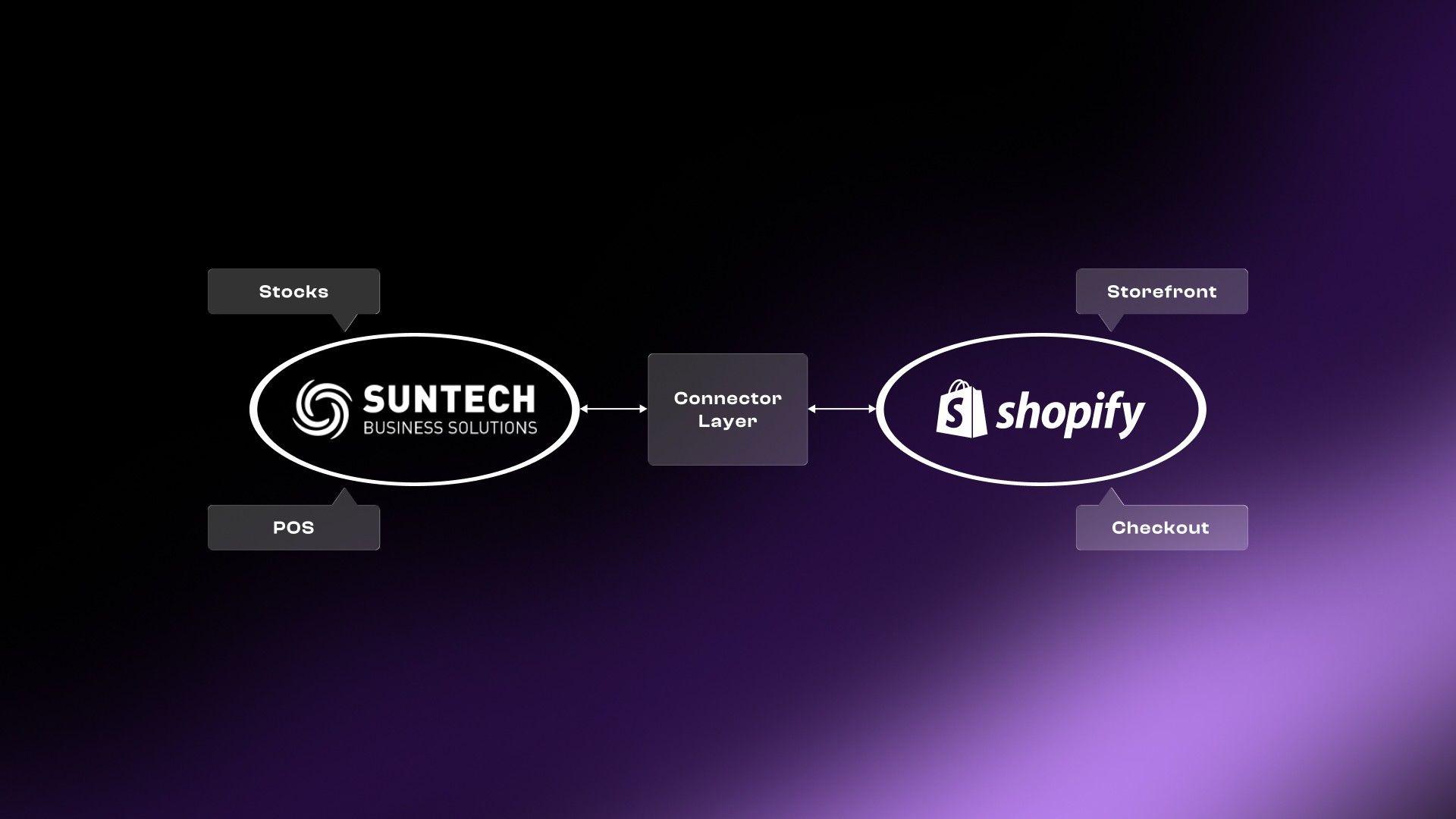
Suntech ERP [SUN FACET 2.0] runs the backbone
Shopify runs growth
The moment these two systems do not speak cleanly, the business pays the price in very visible ways:
And here’s the key point for UAE jewellery brands: Suntech is widely used across the market. If you are on Suntech ERP, you are not alone, and this problem is not unique to your team. The brands that win online are simply the ones that solved this bridge early.
The main issue is simple.
Suntech ERP does not give a ready connector that directly connects to Shopify. So most jewellery brands end up doing stock updates manually, using Excel, CSV exports, or temporary code workarounds.
And jewellery stock is not simple like normal retail. That is why this becomes painful.
A piece can move between showroom, warehouse, and workshop. Shopify needs to show only what is actually available to sell right now.
Some items are reserved for VIPs, store customers, repairs, or approvals. If Shopify sells reserved stock, you create cancellations.
Size, karat, weight range, stones. These small differences create many variants, and mapping them correctly between ERP and Shopify is tricky.
A set is often stored as separate pieces in Suntech ERP, but sold as one bundle online. If one part is missing, the full set should not be sold.
One wrong stock sync can mean a cancelled high value order. In jewellery, that damages trust quickly.
Store billing, Shopify, WhatsApp orders, and sometimes marketplaces all touch the same inventory. If everything is not synced, the online store becomes unreliable.
This is why we built a proven bridge between Shopify and Suntech ERP. We have implemented it for UAE jewellery brands like La Marquise Jewellery, Liali Jewellery, and LeJour, so we already know the common issues and how to handle them safely.
We do not position this as a plug in app you install and forget. Jewellery operations are too complex for that. What we implement is a connector layer that makes Shopify and Suntech ERP work like one system.
Think of it like this.
Your online store becomes one more store inside the ERP ecosystem. Just like your Dubai showroom is a store and your warehouse is a store, Shopify becomes another sales channel that follows the same inventory rules.
Not every piece in your ERP should be sellable online. So we first define online sellable stock based on real operations.
Example: If a piece is in the workshop or reserved for a VIP, Shopify should not sell it. If a piece is available in the showroom or warehouse and ready to dispatch, Shopify can sell it.
We set up two way sync between Shopify and Suntech ERP so both systems stay updated.
What this means in real life: If an item sells on Shopify, the ERP reduces that stock. If an item sells in the showroom, Shopify stock updates as well.
This avoids the classic situation where online and offline teams are selling the same piece without knowing.
Once inventory is accurate, shipping options become simple and reliable.
Example:
This reduces cancellations and builds trust because the customer is not surprised after paying.
Your ops team should not have to manage orders in two places. When Shopify orders flow into Suntech ERP, your existing billing, picking, packing, and dispatch process continues as it is.
Shopify becomes the front end for selling.
Suntech ERP remains the backbone for fulfillment.
During Eid, DSF, wedding season, and BFCM, small sync mistakes become big issues. So we add safeguards like:
That is why this works like magic for the business team. No bluff orders. No late deliveries. Pick up orders stay accurate. The store can confidently sell what is actually available.
For brands like La Marquise Jewellery, this reliability is what helped enable fast delivery promises and still keep operations smooth.
In many implementations, we run inventory updates on real time & event based updates when key sales activity happens. The exact timing depends on store volume, locations, and ERP readiness.
We keep this modular so brands can start small and expand.
Optional, based on how clean the catalog is.
Optional, based on your pricing model.
Optional.
This is important in jewellery.
When Shopify and Suntech ERP are not aligned, ecommerce becomes stressful. Your team hesitates to scale ads, customers see the wrong availability, and operations spend time fixing issues instead of fulfilling orders.
But once the bridge is in place, Shopify becomes a reliable sales channel, not a daily inventory question. Your marketing team can push campaigns confidently, your operations team stays on the same ERP workflow, and your customers get clear delivery expectations from the first click.
If you are a UAE jewellery brand using Suntech ERP and you want Shopify to run smoothly with accurate stock and reliable order flow, we can help.
Book a 30-minute Suntech ERP + Shopify integration consultation with Huptech Web. We will understand your locations, stock rules, and delivery promises and suggest the right sync approach for your business.
In most cases, no. That is why many teams rely on manual updates, CSV exports, or temporary scripts.
It depends on your operations. Many brands start with scheduled sync and event-based updates when key sales activity happens. We recommend the model based on your sales volume, locations, and delivery promises.
Yes. We can sync inventory by location and define what is online sellable. This is critical for fast delivery, pickup orders, and avoiding false out of stock situations.
We can show orders on Shopify with an estimated lead time, so customers are clear from day 1. This reduces cancellations and improves trust.
Yes, reserved stock logic can be added if your business uses holds, repairs, approvals, or store reservations. The goal is to avoid selling stock that is not truly available.
Yes, that is one of the biggest outcomes. When Shopify and ERP inventory match consistently, overselling drops and customers get accurate availability and delivery expectations.
In most cases, no. Once the connector is running, the goal is to remove daily Excel based updates and make ERP the source of truth for stock.
Yes, if your inventory by location is structured properly and the online store can trust what is ready to dispatch. This is exactly why fast delivery becomes possible without bluff orders.
It depends on catalog size and complexity. We usually implement in phases, starting with top sellers and key locations first, then expanding after stability is proven.
Not necessarily. The goal is to keep Suntech ERP as the operational backbone and make Shopify work with it, without disrupting your existing store operations.
Yes, pricing sync and gold rate daily update logic can be added as optional modules, depending on how your business manages pricing.
Access to the Shopify admin, clarity on your location structure, and a short mapping of how you manage stock and reservations in Suntech ERP. We start with a discovery session and define the rules before any live sync begins.
Drop your details and we'll email the download link straight to your inbox.