



E-Commerce•13 Min
A Safe Shopify Go-Live Checklist: Backups, Theme Sync, and Zero-Downtime Deploys

Written byRishi Thacker
Posted onOct 08, 2026



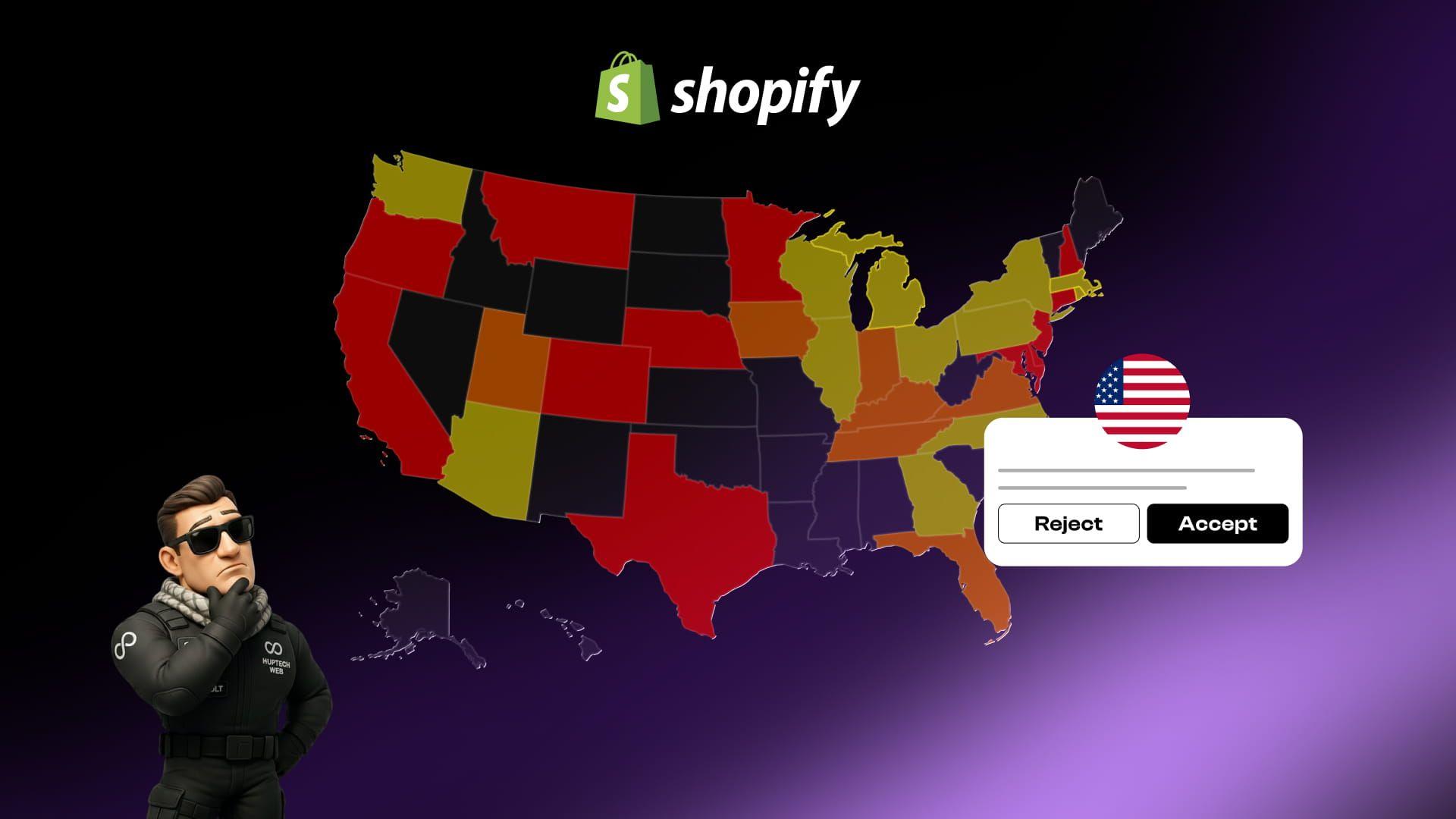
If you're running a Shopify store and shipping anywhere in the United States, there's a compliance storm you can't afford to ignore, and it's already here.
As of January 2026, 20 US states have enacted comprehensive consumer data privacy laws. That's not a prediction. It's the reality right now. And if your store is collecting emails, running Meta Pixel, firing Google Analytics tags, or using any third-party tracking script (spoiler: you are), you're already in the crosshairs.
We manage over 420 Shopify stores at Huptech Web, and here's what we've learned the hard way: most Shopify merchants don't realize they need state-level consent management until an ad campaign breaks, a customer complains, or worse, a regulator comes knocking.
This guide is everything we wish someone had told our clients two years ago.
"But I'm Only Shipping Within the US. Do I Really Need This?"
Short answer: Yes. Absolutely.
Here's the logic most merchants follow: "I'm not selling in Europe, so GDPR doesn't apply to me. I'm fine."
That was almost true in 2023. It's dangerously wrong in 2026
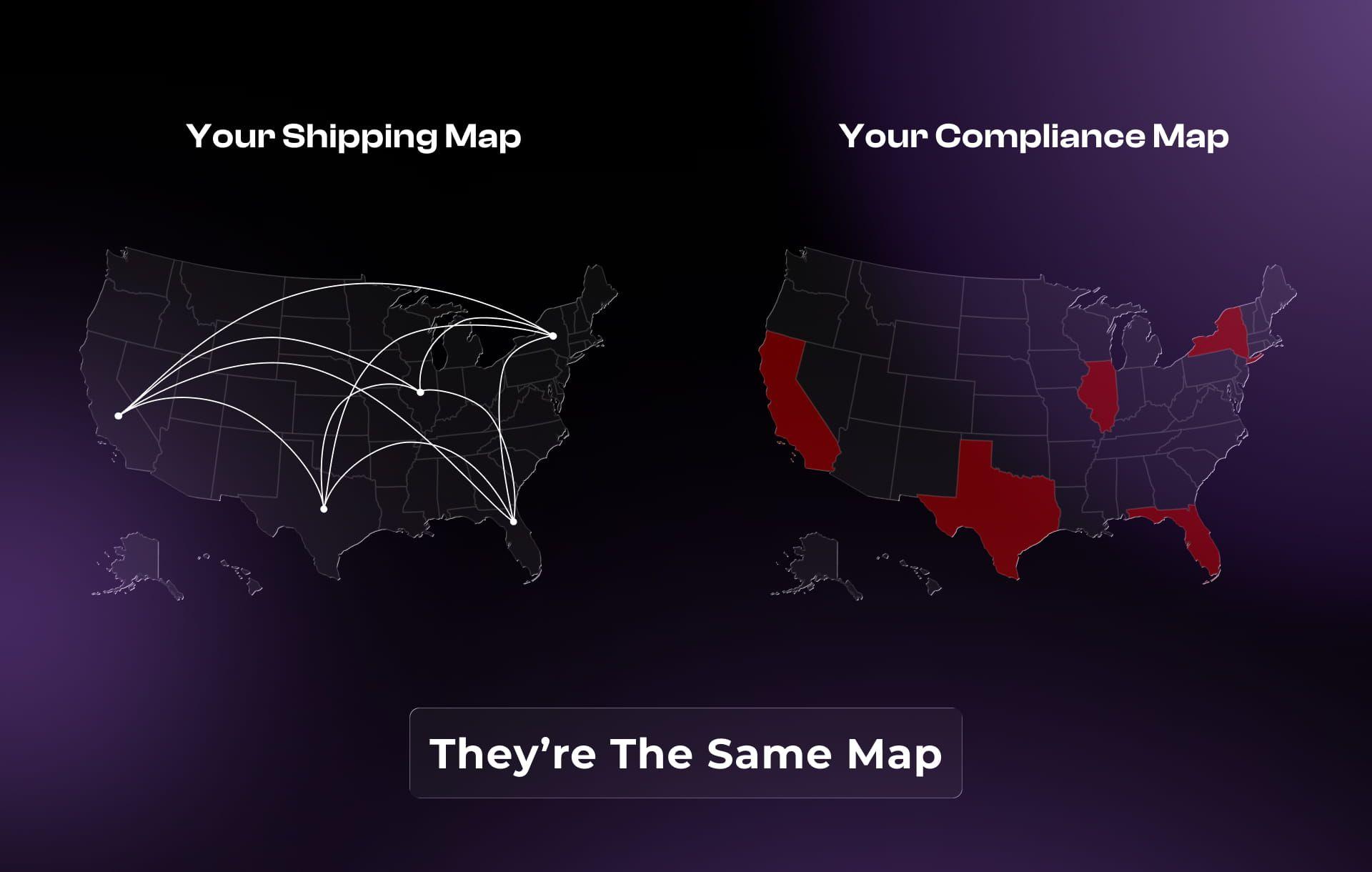
Here's why: if you're shipping domestically across the US, your packages are landing in states that now have their own privacy laws. Laws that are modeled after GDPR in spirit but enforce differently in practice. If a customer in California, Colorado, Connecticut, or any of the other 17 states with active laws visits your site and you're collecting their data without proper consent mechanisms, you're in violation.
And here's the part that catches most merchants off guard: you don't need to be physically located in these states. If a resident of that state visits your online store, their state's privacy law applies to you.
A Shopify store based in Florida shipping a candle to a customer in California? California's CCPA/CPRA applies. A store in New York selling supplements to someone in Texas? The Texas Data Privacy and Security Act applies.
Your shipping map Is your compliance map.
Here's the full picture as of April 2026. We've built this into an interactive map (scroll down or jump to the interactive version) so you can see exactly where your business stands. But first, let's break it down.
These states led the charge and have the most mature enforcement:
Effective: January 1, 2020 (CCPA), amended January 1, 2023 (CPRA)
The gold standard. Applies to businesses that process data of 100,000+ California residents OR earn $25M+ in annual revenue OR derive 50%+ of revenue from selling personal information. California's law is the most aggressive. Fines reach $7,988 per intentional violation. The California Privacy Protection Agency (CPPA) is actively enforcing. In September 2025, Tractor Supply was fined $1.35 million. That was the largest CPPA administrative fine to date, for failing to honor opt-out requests and ignoring Global Privacy Control signals.
Effective: January 1, 2023
The "template state." Virginia's law became the legislative model that Kentucky, Indiana, and several others copied almost word-for-word. Applies to businesses processing data of 100,000+ residents or 25,000+ residents if you derive 50%+ of revenue from data sales. No private right of action. Enforcement is through the Attorney General.
Effective: July 1, 2023
One of the first states to mandate recognition of Universal Opt-Out Mechanisms, like Global Privacy Control (GPC). If your site doesn't detect and honor GPC signals from Colorado visitors, you're non-compliant. Period.
Effective: July 1, 2023; Universal Opt-Out Mechanism required January 1, 2025
Similar to Virginia's framework but with the added GPC/Universal Opt-Out requirement. Connecticut also expanded obligations through 2025 and 2026 amendments, including stricter rules on consent for minors' data.
Effective: December 31, 2023
The most business-friendly of the bunch. Higher thresholds ($25M+ annual revenue AND data processing requirements) and an opt-out-only model with no opt-in consent requirements.
Effective: July 1, 2024; Universal Opt-Out required July 1, 2025
Oregon's law applies broadly, even to nonprofits (unique among state laws). Requires businesses to recognize Universal Opt-Out Mechanisms.
Effective: July 1, 2024; Universal Opt-Out required July 1, 2025
Texas has the broadest applicability: no revenue or data processing thresholds. If you do business in Texas and aren't a small business as defined by the SBA, the law applies. And with Texas being one of the largest ecommerce markets in the US, this one matters.
Effective: July 1, 2024; Universal Opt-Out required July 1, 2025
Lower thresholds than most states (50,000 consumers, not counting payment transactions). Montana's smaller population means you hit the threshold faster with fewer customers.
Effective: July 1, 2024
Florida's law has a narrower scope. It applies to businesses with $1 billion+ in annual revenue or meeting specific data-related criteria. However, it includes unique provisions around children's social media use and voice/facial recognition data that could impact some Shopify merchants in the beauty, health, and wellness space.
Eight more states came online throughout 2025:
Applies to businesses processing data of 35,000+ Delaware residents (excluding payment transactions) or 10,000+ residents if you earn 20%+ revenue from data sales. One of the lower thresholds. Universal Opt-Out required January 1, 2026.
Opt-out only, no opt-in consent requirements. Higher thresholds (100,000 consumers or 50%+ revenue from data of 25,000+). More business-friendly.
Applies at 35,000 consumers or 10,000+ with 25%+ revenue from data sales. Requires Universal Opt-Out Mechanism recognition from January 1, 2025.
Unique: no processing threshold at all. If you process personal data of Nebraska residents, the law applies. Universal Opt-Out required from day one.
Applies at 100,000 consumers or 25,000+ with revenue from data sales. Includes consent requirements for sensitive data. Universal Opt-Out required January 15, 2025.
Follows the Virginia model closely. 175-day cure period, the most generous of any state, giving merchants time to fix violations before penalties apply.
Among the most consumer-protective state laws. Includes a unique "profiling" opt-out right and requires Universal Opt-Out recognition.
One of the strictest: limits data collection to what is "reasonably necessary" and restricts the sale of sensitive data entirely. Also requires data protection assessments.
Three states kicked off 2026 with new laws:
Follows the Virginia template. 100,000 consumer threshold or 25,000+ with 50%+ revenue from data sales. 30-day cure period.
Nearly identical to Virginia's structure. Notable for its broad definition of "sale," covering not just monetary exchanges but analytics and advertising data sharing.
The 20th state. Lower thresholds: 35,000 residents or 10,000+ with 20%+ revenue from data sales. Rhode Island's definition of "sale" is one of the most expansive. It potentially includes data shared with analytics and advertising services, making it especially relevant for Shopify stores running ad pixels.
Let's get specific about why Shopify merchants face unique compliance risks.
Every Shopify store runs apps. Review apps. Email marketing apps. Pop-up apps. Live chat apps. Analytics apps. Each of these injects scripts that set cookies and collect data, often before a visitor has given any consent at all.
Here's the critical gap: Shopify's built-in privacy banner displays a consent notice but does not enforce prior blocking. That means your Meta Pixel, TikTok tracking code, Hotjar scripts, and Google Analytics tags can fire before a visitor clicks "Accept." Under GDPR and many US state laws, displaying a banner without actually blocking scripts until consent is given is considered a misleading practice, and regulators are specifically looking for this.
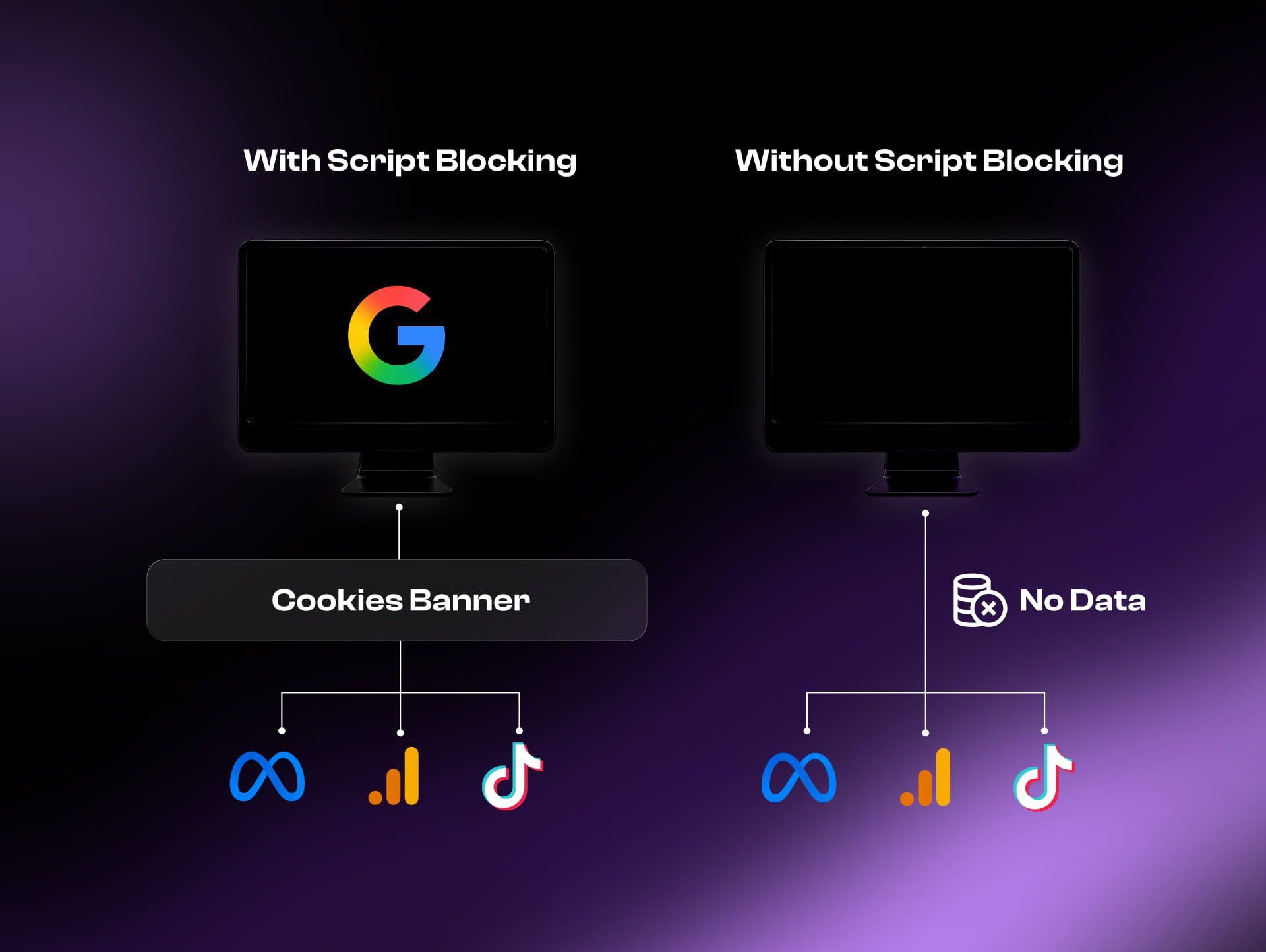
This is the part that makes merchants pay attention. If you're running Meta Ads, Google Ads, or TikTok Ads, your tracking pixels are collecting data from visitors in all 50 states. If those pixels fire before consent is given to visitors from states that require opt-in or opt-out mechanisms, you're in violation, and your ad data is technically tainted.
We've seen this firsthand across our merchant base. When ad platforms can't verify that data was collected with proper consent, they limit your targeting capabilities. Conversion tracking breaks. Lookalike audiences shrink. Your ROAS drops, not because your creativity is bad, but because your consent infrastructure is broken.
Your ad performance depends on clean, consented data.
Let's do the math that makes CFOs lose sleep.
California's CPRA imposes fines of up to $7,988 per intentional violation, and each affected consumer counts as a separate violation. If your Shopify store gets 10,000 visitors per month from California and your consent banner isn't properly blocking scripts, that's potentially 10,000 violations per month.
10,000 x $7,988 = $79.8 million in potential fines per month.
Is that the worst-case scenario? Yes. Is it realistic for most small merchants? No. But even a fraction of that is devastating for a small business. And California isn't bluffing. Disney settled for 1.1 million, and Ford for $375,703. The CPPA reported hundreds of active investigations throughout 2025.
The Tractor Supply case is the one every ecommerce business should study. They had a "Do Not Sell My Personal Information" link on their site. Users clicked it, filled out a form, submitted opt-out requests. But the system never actually stopped selling their data through third-party tracking scripts. The banner was there. The form was there. The compliance was an illusion.
$1.35 million fine.

There's a new compliance layer that most merchants haven't even heard of yet: Global Privacy Control (GPC).
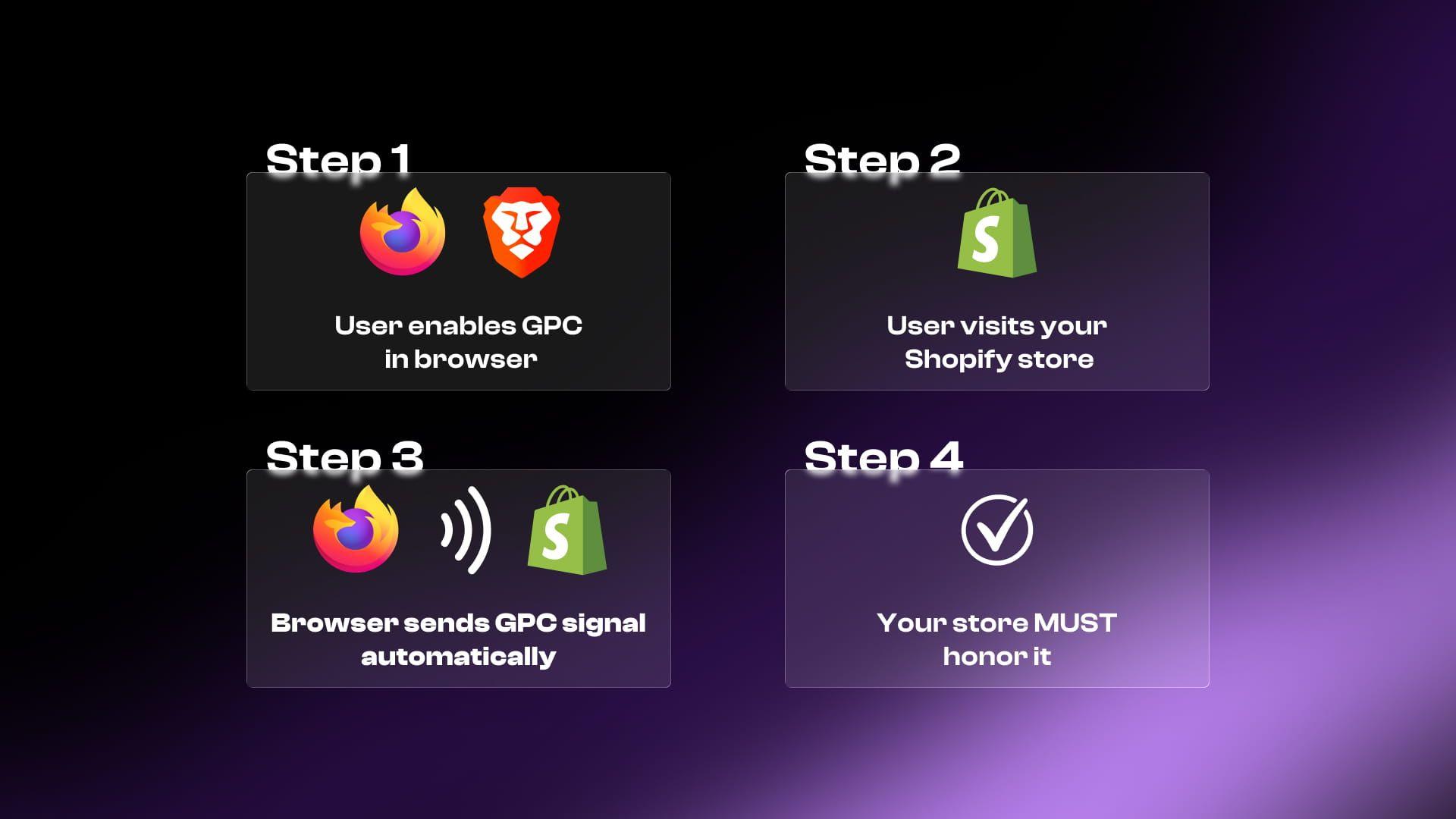
GPC is a browser-level signal that automatically communicates a user's opt-out preference. When a user enables GPC in their browser (available in Firefox, Brave, DuckDuckGo, and via browser extensions), every HTTP request they send includes a signal saying "I opt out of the sale and sharing of my personal data."
As of January 2026, twelve states legally require businesses to honor GPC signals: California, Colorado, Connecticut, Delaware, Maryland, Minnesota, Montana, Nebraska, New Hampshire, New Jersey, Oregon, and Texas.
Here's the compliance trap: if a GPC-enabled visitor lands on your Shopify store and your consent management setup doesn't detect and honor that signal, you're in violation in twelve states simultaneously, without the visitor ever clicking anything on your consent banner.
Your consent tool needs to detect the navigator.globalPrivacyControl flag, suppress data selling and targeted advertising for that user automatically, and (under California's new regulations) display an "Opt-Out Request Honored" message.
Most basic cookie consent apps don't do this.
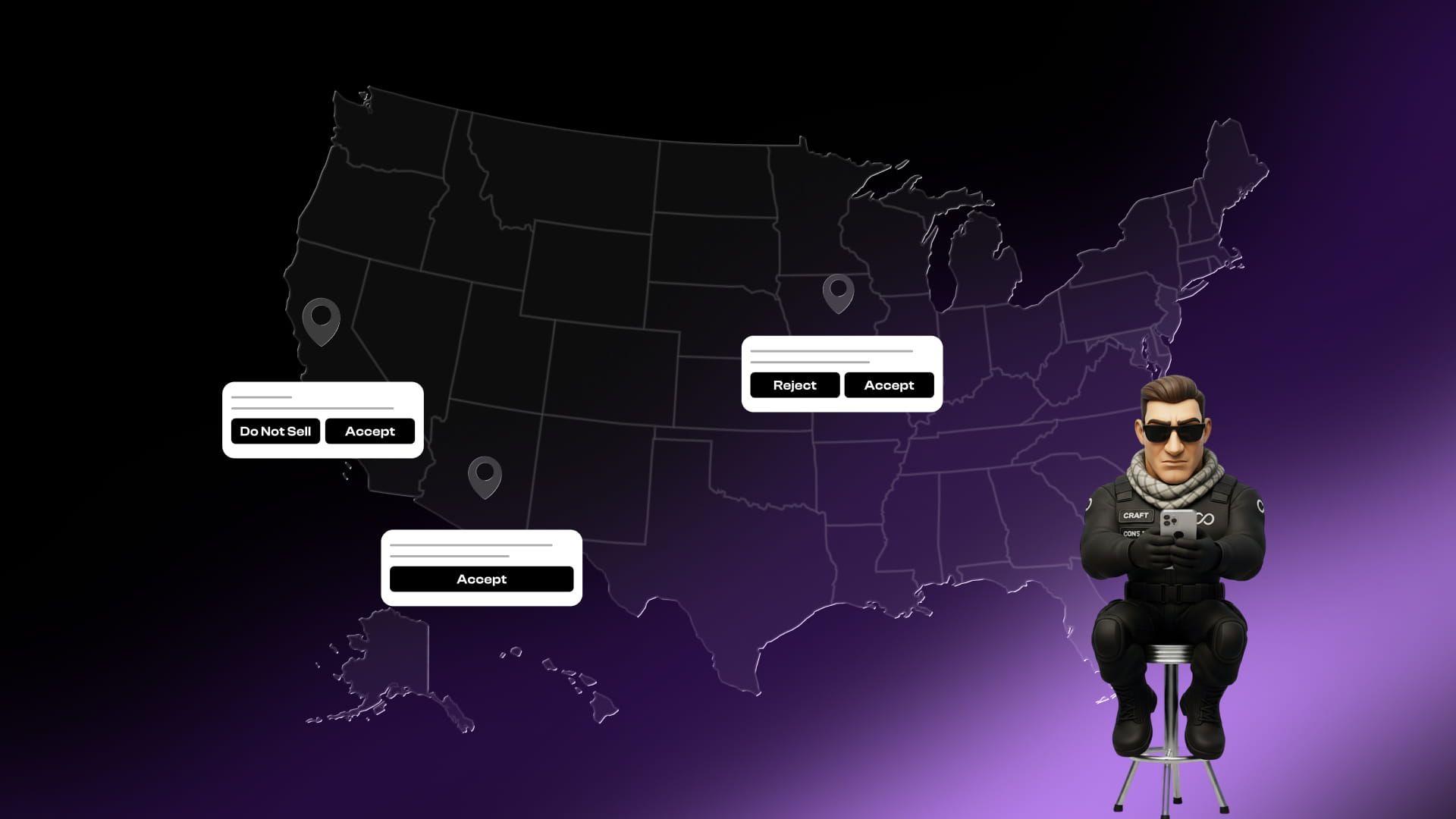
Which US states have active consumer privacy laws, who needs Universal Opt-Out, and what it means for your Shopify store — updated for 2026.
The takeaway from this map is stark: if you're shipping across the US, you're shipping into a patchwork of 20 different compliance requirements. A single consent banner that treats all visitors the same isn't just lazy. It's a liability.
Here's where most consent tools fall apart: they show the same cookie banner to every visitor, regardless of where that visitor is coming from.
Think about why that's a problem:
A visitor from California needs to see a banner that offers opt-out options for data sales and targeted advertising, honors GPC signals automatically, and includes specific CCPA/CPRA-required disclosures.
A visitor from Connecticut needs a banner that recognizes Universal Opt-Out Mechanisms and offers opt-out of targeted advertising, profiling, and data sales.
A visitor from Iowa only needs an opt-out mechanism. No opt-in consent required.
A visitor from a state without a comprehensive privacy law (say, Arizona or New York) doesn't legally need a consent banner at all. Showing them one just adds friction to their shopping experience and potentially hurts your conversion rate.
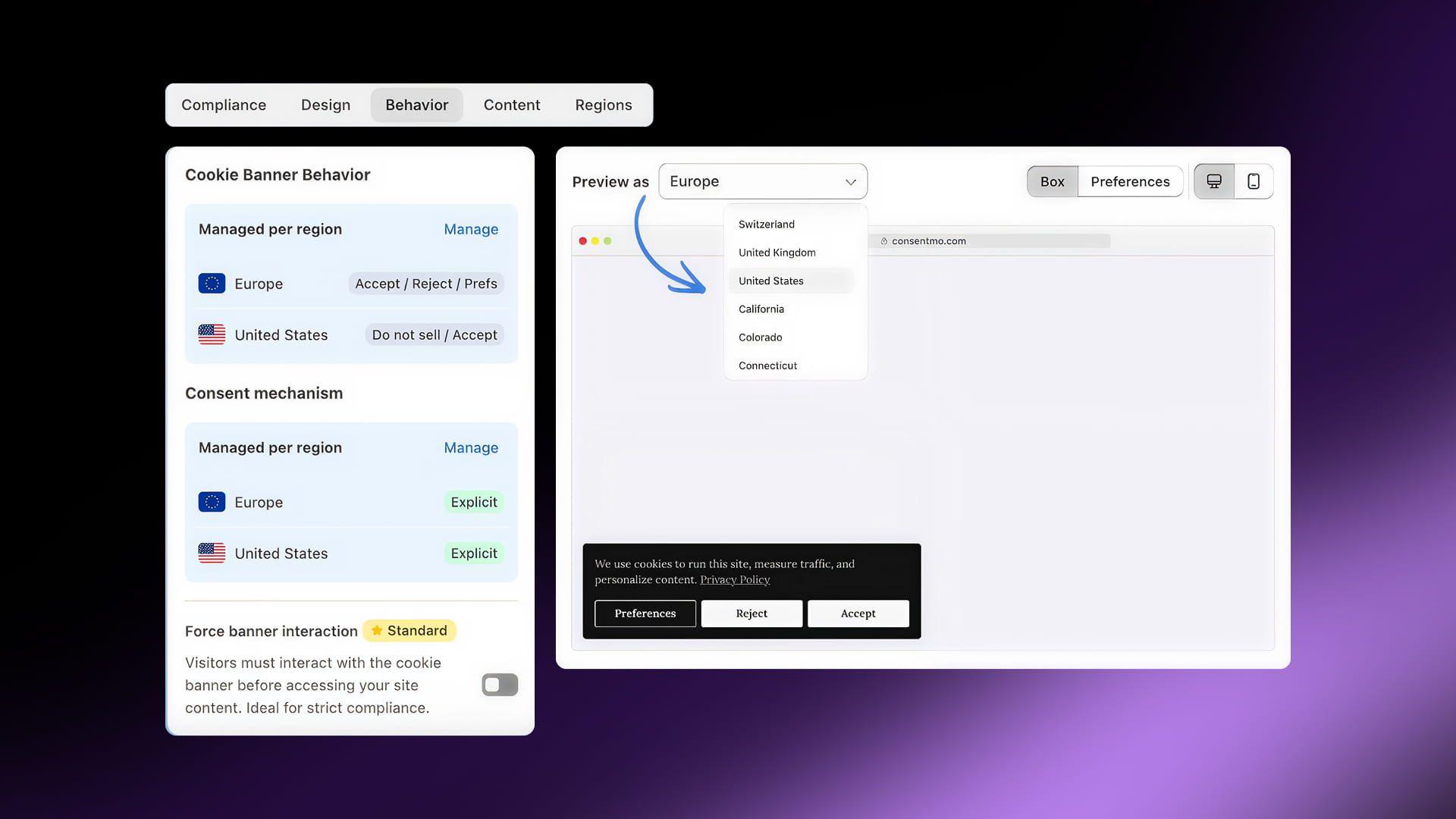
Granular compliance means your consent infrastructure automatically detects where a visitor is located (via IP geolocation) and shows the appropriate consent experience: right banner, right options, right legal language, for that specific region.
This isn't a nice-to-have anymore. It's the only way to be compliant in California without annoying visitors from states that don't require banners, and it's the only way to maintain your conversion rate while meeting legal obligations.
Based on our experience managing 420+ stores, here's what a proper compliance setup looks like on Shopify in 2026:
Your consent tool needs to detect visitor location at the state level and serve different consent experiences accordingly. It also needs to honor GPC/Universal Opt-Out signals automatically, block scripts until proper consent is given (not just display a banner), and provide a compliance health check so you can verify your setup is actually working.
We've tested multiple solutions across our merchant base. Consentmo is the tool we recommend for Shopify stores. It's one of the few apps in the Shopify ecosystem that offers true region-and-state-level granular consent configuration. You can configure different banner types for different US states and international regions, preview how your banner looks for visitors from each location without needing a VPN, and it handles GPC signal detection out of the box.
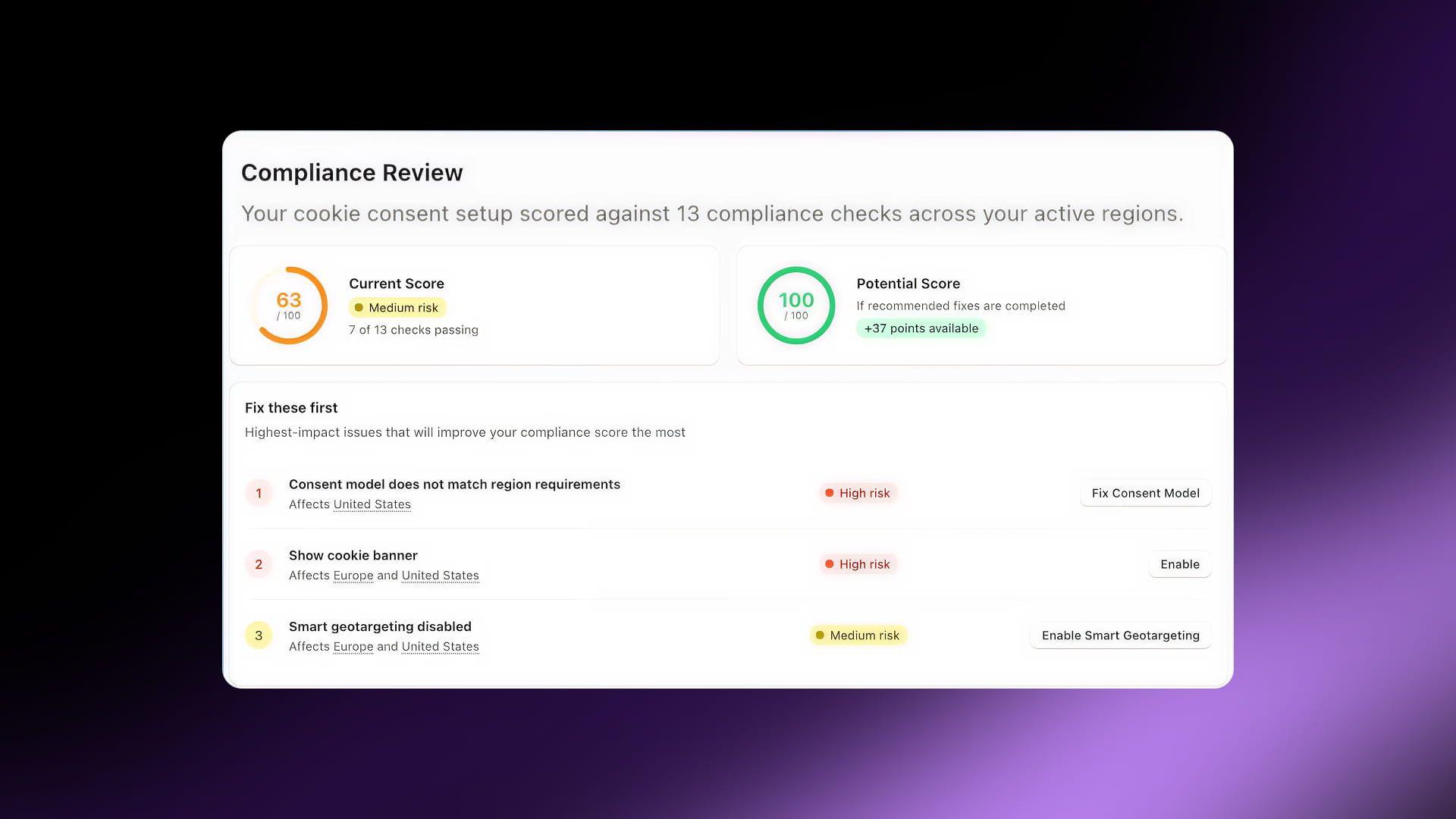
Their recently launched compliance health score is particularly useful. It works like a PageSpeed score but for privacy, showing you exactly where your store is compliant and what needs fixing.
Your consent platform must actually block third-party scripts (Meta Pixel, Google Analytics, TikTok Pixel, etc.) until consent is obtained. Displaying a banner while scripts fire in the background is worse than having no banner at all. It creates a false sense of compliance while still violating the law.
If you're running Google Ads, your consent tool needs to support Google Consent Mode v2. Without it, your conversion data will be incomplete and your ad performance will suffer. This is especially critical after Google's enforcement of Consent Mode v2 requirements for advertisers.
Several state laws require you to maintain records of consent obtained. Your consent tool should log when and how consent was given, store consent receipts, and be able to produce records if a regulator or attorney asks.
Let's paint the realistic scenario for a Shopify store that ignores all of this:
Month 1 to 3: Nothing visible happens. Your store runs normally. You might see a few privacy policy complaints from European visitors.
Month 4 to 6: Your Meta Pixel starts sending less data as browsers with built-in tracking prevention (Safari, Firefox, Brave) block your cookies. Your ad ROAS dips by 10-20%. Your marketing team blames creative fatigue.
Month 7 to 9: A customer in California exercises their right to opt out. You don't have a mechanism to honor it. They filed a complaint with the CPPA. An investigation begins.
Month 10 to 12: You receive a notice of violation. California gives you 30 days to cure. You scramble to implement a consent solution retroactively. But the data you collected without consent over the past year? That's still a violation.
Month 13+: Potential fines. Legal fees. And a permanent black mark on your business's compliance record.
This isn't hypothetical. It's the trajectory we've watched play out with merchants who delayed compliance "until it becomes a real issue." By the time it's a real issue, it's a real expensive issue.
Here's the practical action plan for any Shopify store owner reading this:
Open your Shopify store in a browser with GPC enabled (Firefox or Brave). Does your store recognize the signal? Does your consent banner even appear? Use a VPN to check your store from a California IP, a European IP, and a state without privacy laws. Is the experience different? It should be.
Go to your Shopify admin > Online Store > Themes > Edit code. Search for third-party scripts. Check your apps, each one likely injects scripts. Document every cookie and tracker on your site.
Set up Consentmo or an equivalent tool that supports state-level geolocation, GPC detection, and prior script blocking. Configure different consent experiences for different regions.
Run the health score audit. Fix every issue flagged. Aim for 100/100. Partial compliance is still non-compliance.
Make sure your consent setup integrates with Google Consent Mode v2 and doesn't break your conversion tracking. Your ads person should understand what's changing and why.
Privacy laws are moving fast. Three new states went live in January 2026 alone. Set a calendar reminder to review your consent configuration every quarter as new laws take effect and existing ones get amended.
The US consent landscape in 2026 isn't what it was even 12 months ago. With 20 states now enforcing comprehensive privacy laws, Universal Opt-Out mandates in 12 of them, and regulators actively issuing million-dollar fines, the question isn't whether you need compliance. It's how quickly you can get there.
Your shipping map is your compliance map. If you're selling across the US, you're selling into 20 different regulatory environments. A single, one-size-fits-all cookie banner isn't just inadequate. It's a ticking liability.
The good news? With the right tools and setup, compliance doesn't have to be painful. Granular consent management lets you stay compliant in every state while minimizing friction for visitors in states that don't require banners. It protects your ad data, your revenue, and your business.
If you're managing a Shopify store and feeling overwhelmed by all of this, reach out to our team at Huptech Web. We've helped hundreds of merchants navigate this exact challenge, from consent setup to full store performance audits.
And if you want to see what granular consent management actually looks like in action, check out Consentmo. It's what we use and recommend across our merchant base.
Your customers trust you with their data. Make sure you deserve that trust.
This post is part of a collaboration between Huptech Web and Consentmo. Huptech Web is a Shopify Plus agency managing 420+ stores worldwide. Consentmo is a Shopify consent management platform offering granular, region-specific compliance for merchants in 100+ countries.

Drop your details and we'll email the download link straight to your inbox.