



E-Commerce•10 Min
Replatform or Optimize? A Decision Framework for Ageing Ecommerce Stores (2026)

Written byRishi Thacker
Posted onSep 16, 2026
We’re exhibiting at Seamless Middle East 2026



Your Products Are Already in ChatGPT. But Are They Getting Recommended?
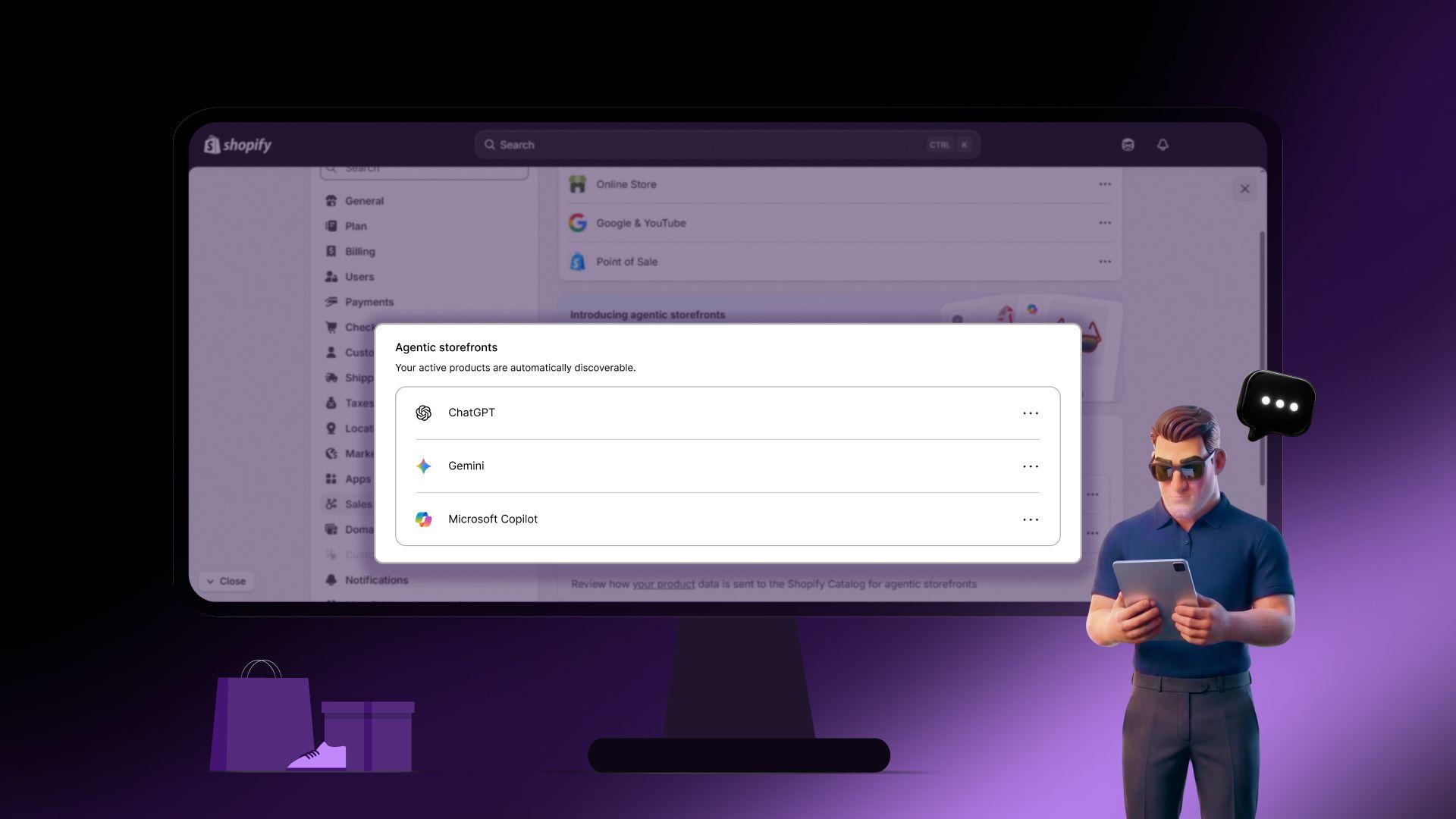
Here's something every Shopify merchant needs to understand right now. As of March 24, 2026, your products are discoverable inside ChatGPT, Google Gemini, Microsoft Copilot, and AI Mode in Google Search. All 5.6 million eligible Shopify stores. No apps. No setup fees. No opt-in required.
It's on by default.
But "discoverable" doesn't mean "recommended." And that distinction is costing most merchants sales they don't even know they're losing.
AI agents don't browse your store like a human. They parse structured data and make confidence-based decisions about which products to surface. When someone asks ChatGPT "what's the best organic face cream under $40," the AI isn't scrolling through product pages. It's querying Shopify Catalog, evaluating product attributes, and returning the products it can most confidently recommend.
Most Shopify stores have thin product data, vague titles, incomplete attributes, descriptions that read like marketing copy instead of structured information. That's exactly the kind of data AI agents skip.
The numbers tell you why this matters:
The merchants with clean, structured, attribute-rich product data are getting the recommendations, and the revenue. Everyone else is technically discoverable but practically invisible.
This post is the playbook for making sure you're in the first group.
Shopify's Agentic Storefronts feature connects your products to every major AI shopping platform through a single integration. Here's what's active:
The flow works like this: your products feed into Shopify Catalog, a massive product database powered by specialized machine learning models. These models categorize your products, extract attributes, consolidate variants, and standardize your data. AI platforms then pull from this Catalog to serve recommendations. When a customer is ready to buy, they click through to your actual Shopify checkout.
You set up once. Shopify syndicates everywhere. Every order flows back into your admin with full channel attribution. You stay the merchant of record. The customer relationship is yours.
The setup is essentially a toggle. Go to your Shopify Admin, check your Sales Channels settings, and verify Agentic Storefronts is active. For most stores, it already is.
Here's the gap most merchants don't see. Being in Shopify Catalog and actually getting surfaced by AI agents are two very different things.
AI agents make confidence-based decisions. When ChatGPT gets a shopping query, it evaluates products across dozens of attributes, title accuracy, description completeness, structured data quality, inventory availability, pricing clarity, review signals. The products it surfaces are the ones where it has the highest confidence it's making a good recommendation.
Most Shopify stores have 5–8 structured attributes per product. AI agents need 30+ to make confident recommendations. That's the gap.
Here's what causes products to get skipped:
Stores with 99%+ attribute completion see 3–4x higher AI visibility. That's not marginal. That's the difference between showing up and not showing up.
Here's the tactical work. Eight steps, in priority order, to make your products the ones AI agents recommend.
Start by knowing what you're working with. Pull up your Shopify product catalog and evaluate every listing: Is the title descriptive and specific? Does the description include factual attributes? Are all variant options properly structured? How many metafields are populated per product?
Shopify's Catalog sync health dashboard shows rejection rates and data quality signals. Check it. If products are being rejected or partially synced, that's your starting point.
This is the highest-impact single change you can make. Your product description generates 7 derivative fields that AI agents use for matching. Shopify Catalog's ML models extract categories, attributes, and comparison data directly from your description text.
Write descriptions that are:
A description that says "This amazing tee is perfect for any occasion!" gives AI zero useful data. A description that says "6.1oz heavyweight 100% ring-spun cotton unisex tee with reinforced collar stitching, available in 12 colors, pre-shrunk and true to size" gives AI everything it needs to recommend your product to someone searching for "durable cotton t-shirt that won't shrink."
AI agents query structured fields, they don't parse paragraphs. Populate these metafields for every product:
Use Shopify's product taxonomy system. Aim for 30+ structured attributes per product.
Group all variants, sizes, colors, materials, under a single parent product. Don't create separate product pages for each variant. AI agents need to understand that your "Trail Runner" comes in 6 sizes and 4 colors, not that you sell 24 different shoes.
Shopify Catalog clusters identical items and consolidates variants automatically, but messy source data creates messy results. Clean input equals better AI output.
Real-time inventory sync is critical. AI agents check stock availability before making recommendations. If your inventory data is delayed or inaccurate, agents skip your products entirely, they won't risk recommending something that's out of stock.
Audit your inventory sync frequency. If you're using a third-party system (ERP, WMS), make sure it's pushing updates to Shopify in real time, not on a daily batch schedule.
AI platforms display images in their recommendations. Multiple angles, clean backgrounds, and lifestyle shots all improve click-through rates from AI conversations.
Include at least 3–5 images per product: hero shot on white background, lifestyle/in-use image, detail shots for material and construction, and scale/size reference images. Use descriptive alt text that includes product attributes, AI systems read alt text.
Schema markup is how AI agents understand your products without parsing your HTML. Implement JSON-LD schema for:
Google explicitly recommends JSON-LD for AI-readable structured data. Validate your implementation using Google's Rich Results Test.
AI platforms pull from your entire site when deciding what to recommend. Pages that answer real shopping questions in natural, conversational language are gold for AI discovery.
Build these content types:
Think about what someone would type into ChatGPT when they're ready to buy. Then make sure your site has content that answers that question better than anyone else's.
Understanding how Shopify Catalog processes your data helps you optimize more effectively.
When your product data enters the Catalog, Shopify's ML pipeline:
Your product description is the single most important input. Catalog generates 7 derivative fields from it. Clean, detailed, attribute-rich descriptions produce better categorization, better attribute extraction, and better AI recommendations.
The critical point: you control the input. Shopify's ML handles the transformation. But garbage in means garbage out.
You can't optimize what you can't measure. Here's how to track whether your optimization is working:
Set a 30-day baseline before and after optimization. Product data improvements typically show results within 2–4 weeks as AI engines recrawl and reindex your data.
The window to establish your brand in AI recommendations is right now. Shopping habits are being formed inside ChatGPT, Gemini, and Copilot today. The brands that show up first build compounding advantages, AI systems learn which products get clicked, purchased, and reviewed positively. Those signals reinforce future recommendations. Early movers don't just get a head start. They get a flywheel.
Product data quality is no longer just operational hygiene. It's the prerequisite for discoverability in the biggest new commerce channel since social. The merchants who treat their product data as a strategic asset, who invest the time to populate every attribute, rewrite every description, and implement proper schema markup, are the ones AI will recommend.
Everyone else will wonder why their traffic is flat while their competitors are getting sales from a channel they didn't even know existed.
Don't wait for your competitors to figure this out first.
Need help optimizing your product data for AI discovery? At Huptech Web, we're helping Shopify merchants get their products recommended by ChatGPT, Google AI, and every major AI shopping platform.
Read More: Your Shopify Store Is Now Shoppable Inside ChatGPT, What to Do
Read More: GEO for Shopify: How to Get Your Products Recommended by AI
No. If you're on Shopify and your store is eligible, Agentic Storefronts is enabled by default. Your products are automatically added to Shopify Catalog, which syndicates them across AI platforms. You can verify the setting in your Shopify Admin under Sales Channels.
OpenAI charges a 4% fee on sales completed through ChatGPT. Google AI Mode currently charges 0%, no additional fees beyond standard Shopify processing. Microsoft Copilot is also at 0% during early access.
The most common reasons: thin product data (vague titles, empty metafields), inaccurate inventory, missing structured data markup, or products that don't match the queries shoppers are asking. Follow the 8-step playbook in this post to improve your AI visibility.
At minimum: descriptive titles under 150 characters, detailed descriptions with factual attributes, accurate pricing, real-time inventory, and high-quality images. But "minimum" won't get you recommended. Stores with 30+ structured attributes per product see 3–4x higher AI visibility.
Agentic Storefronts is available across Shopify plans. Your products enter Shopify Catalog regardless of your plan tier.
Traditional SEO optimizes for Google's ranking algorithm. AI optimization (GEO, Generative Engine Optimization) focuses on structured data quality, attribute completeness, and conversational content that AI agents can parse and confidently recommend. There's overlap, but the emphasis is different.
Yes. You can manage which products are included in Shopify Catalog through your admin settings. You can toggle specific AI channels on or off. But which products get recommended is driven by data quality, not manual selection.
Technical changes like schema markup and metafield population can show impact within 2–4 weeks as AI engines recrawl your data. Content improvements typically take 4–8 weeks. Product data quality is an ongoing investment, not a one-time fix.